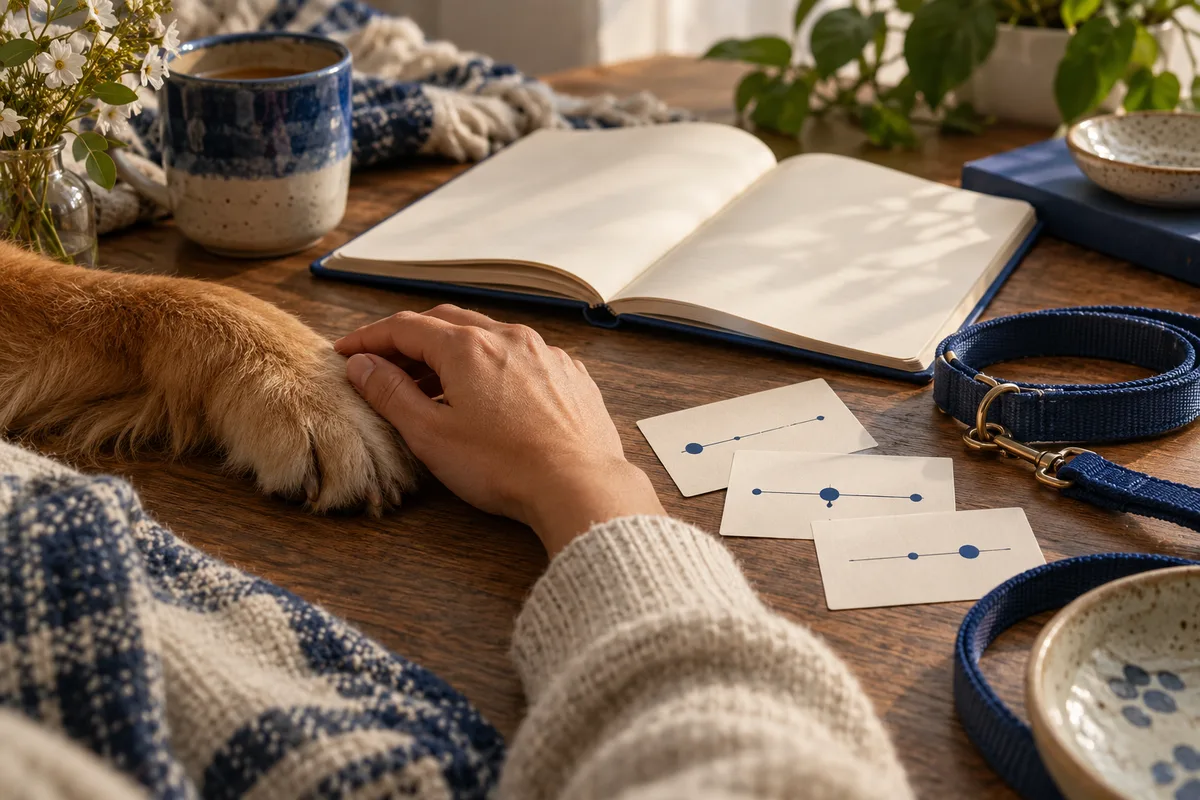
Research suggests group-level associations between some owner personality tendencies and reported pet bonds. Neuroticism is linked with attachment anxiety in one study and with stronger reported bond scores in another; conscientiousness is associated with stronger bond scores in one study. These outcomes are different. The findings cannot explain an individual relationship or establish care quality, cause, or character.
What can research say about an owner's personality and pet bond?
Research suggests modest group-level links between personality and owners' reports of their bond with a companion animal. Strong affection, worry about a pet's safety or availability, and discomfort with closeness are different experiences. A bond-strength questionnaire cannot identify which describes a relationship or how well an animal is cared for. In the 2024 cross-sectional study “Pet attachment and owner personality,” 938 adult dog and cat caregivers completed online measures; neuroticism and conscientiousness were associated with higher reported bond-strength scores. A Finnish study, “Pet and owner personality and mental wellbeing associate with attachment to cats and dogs,” modeled data from 2,724 owners, 92% women. It linked neuroticism with anxious attachment in dog and cat owners, and also reported associations involving pet characteristics and owner well-being. The findings address different aspects of attachment. Because both studies are observational, they cannot establish what caused a reported bond or worry. For reflection, first name what you notice: affection, recurring worry, or distance. Ask whether it appears across ordinary situations or alongside a change in the animal's behavior or circumstances. One action cannot settle that question. Treat personality as a lens on recurring patterns, not a verdict about an owner, relationship, or care.
Sources: Pet attachment and owner personality; Pet and owner personality and mental wellbeing associate with attachment to cats and dogs
What do 'bond strength,' anxiety and avoidance actually measure?
A strong reported bond and an anxious attachment orientation can overlap, but they answer different questions. The Lexington Attachment to Pets Scale (LAPS) asks about the felt strength of the owner–pet bond. The Pet Attachment Questionnaire (PAQ) separates two orientations: anxiety about the pet's availability and closeness, and avoidance, or discomfort with dependence and emotional closeness. A high LAPS result alone cannot tell whether closeness feels secure, anxious, or distant. These are related but non-equivalent measures. That distinction matters when studies appear to disagree. “Attachment” can mean reported connection strength or a pattern of expectations and reactions. A trait associated with stronger bond scores need not indicate greater security; a link with anxiety does not establish unusually strong affection. Check what researchers asked participants to report. The 2024 study “Pet attachment and owner personality” used LAPS as its outcome. In a cross-sectional online survey, 938 adult primary caregivers of dogs or cats completed personality and bond questionnaires. LAPS used 23 statements rated on a four-point agreement scale to measure bond strength. They found neuroticism and conscientiousness associated with higher LAPS scores. This is evidence about reported strength in that sample, not PAQ anxiety or avoidance. As a one-time owner survey, it cannot show why scores differed or how relationships changed. The University of Haifa record for “An attachment perspective on human-pet relationships: Conceptualization and assessment of pet attachment orientations” describes studies that developed the self-report questionnaire and examined its structure, expectations about pets, and reactions to pet loss. The researchers identified individual differences in anxiety and avoidance, which contributed uniquely to predicting expectations about the pet and emotional reactions to its death. This supports treating the orientations as distinct constructs. It is not an observation of daily care, diagnosis, or measure of love. Consider two owners who both say their pet matters deeply. One may feel steady when the animal spends time alone; another may often fear separation or harm. Similar felt closeness does not settle that difference. An owner who is less expressive or protective of personal space may report lower comfort with dependence without caring less. These examples show why intensity, worry, and distance should not be collapsed. A useful reading rule is simple: name the instrument and dimension before interpreting a personality association. LAPS findings concern reported bond strength. PAQ findings concern reported anxiety and avoidance. Both rely on the owner’s account; neither independently establishes animal behavior or care quality. Once the outcome is clear, ask whether a result concerns felt closeness, worry about availability, or discomfort with dependence. That distinction prevents a group-level association from becoming an unsupported verdict about an individual relationship.
Sources: Pet attachment and owner personality; An attachment perspective on human-pet relationships: Conceptualization and assessment of pet attachment orientations
Which owner tendencies recur in studies of bond strength?
The clearest signal in research on overall pet-bond strength concerns two broad personality tendencies: neuroticism and conscientiousness. In the 2024 study “Pet attachment and owner personality,” both were associated with higher scores on the Lexington Attachment to Pets Scale (LAPS), a questionnaire about the strength of an owner’s reported bond. The finding says that these tendencies varied alongside reported closeness in that sample. It does not show that a worried person loves a pet more, or that an organized person necessarily provides better care. The study used a cross-sectional online survey, meaning owners’ answers were gathered at one point rather than tracked over time. Adults from around the world were invited through social media; the analysis included 938 primary caregivers who completed the survey, 759 focused on a dog and 179 on a cat. Participants reported personality through a Big Five measure and bond strength through the 23-item LAPS. In the study’s regression analysis, neuroticism and conscientiousness significantly predicted LAPS scores. “Predicted” here describes a statistical relationship in the model; it does not mean the traits forecast future behavior or caused stronger bonds. Because the survey was self-selected and relied on owners’ reports, its results cannot establish what would be found in a representative population or in any one household. The other Big Five tendencies did not emerge as significant predictors in that analysis. Nor did any of the three Dark Triad traits, a set of measures covering Machiavellianism, narcissism and psychopathy. This is a useful check against turning one result into a broad personality portrait. The study does not support claims that every trait maps neatly onto pet attachment, or that a particular profile identifies a “dog person,” a “cat person” or a style of caregiving. Its authors distinguish the strength of the bond they measured from its quality or attachment style, and call for further study of both. That distinction matters when comparing the result with the 2023 Finnish study “Pet and owner personality and mental wellbeing associate with attachment to cats and dogs.” Using questionnaires from 2,724 Finnish owners, that study modeled owner and pet characteristics alongside owner well-being. It linked owner neuroticism with anxious attachment for both dog and cat owners. This is suggestive because neuroticism appears in research on both reported bond strength and attachment anxiety, but the outcomes are not interchangeable: feeling strongly bonded is not the same thing as worrying about a pet’s availability or safety. The Finnish study was also cross-sectional, and 92% of its participants were women, which limits how far its pattern can be generalized. Taken together, these studies make neuroticism a plausible group-level correlate worth examining, while conscientiousness appears in this evidence for bond strength. They do not provide a personal reading. If someone recognizes frequent concern, the research alone cannot tell whether it reflects a recurring tendency, a relationship, or a current change in the animal’s behavior. The practical question is what the person notices over time and under different conditions. A trait can be one interpretation to consider, but a population association cannot settle an individual explanation or grade the care a pet receives.
Sources: Pet attachment and owner personality; Pet and owner personality and mental wellbeing associate with attachment to cats and dogs
Why does neuroticism point more clearly to worry than to love?
Neuroticism is a broad personality tendency involving greater sensitivity to negative emotion, such as worry or distress. In pet-attachment research, its clearest link is with reported attachment anxiety, not with a measurable quantity of love. Attachment anxiety refers here to concern about the relationship or the pet’s availability; it is a questionnaire pattern, not a diagnosis. A worried owner may read frequent checking as proof of devotion, or as proof that something is wrong with their personality. Neither conclusion follows from the evidence.
The Finnish study “Pet and owner personality and mental wellbeing associate with attachment to cats and dogs” used structural equation modeling to examine questionnaire responses from 2,724 Finnish pet owners, 92% of whom were women, and reports that owner neuroticism and poorer mental well-being were associated with anxious attachment in both dog and cat owners. It also considered pet characteristics and unwanted behavior. The cross-sectional design captures associations at one period; it cannot establish whether a tendency preceded the relationship pattern, whether circumstances contributed to worry, or whether other influences shaped both. The study makes a broad trait explanation plausible at group level, but cannot identify the explanation for an individual owner.
A separate global online survey, “Pet attachment and owner personality,” included 938 adult primary caregivers of dogs or cats. It found neuroticism associated with higher scores on the Lexington Attachment to Pets Scale, which measures reported bond strength. Bond strength and attachment anxiety are not interchangeable. The study did not show that neuroticism means greater love, and its one-time self-report design cannot establish cause. Read alongside the Finnish findings, it suggests neuroticism may relate to more than one reported aspect of the bond. It cannot explain one person’s checking or distress.
For an individual, two explanations can fit the same visible action. Repeatedly checking whether a pet is nearby might reflect a broader tendency to become concerned across ordinary situations. It might also be a response to a concrete change: the pet has behaved differently, seemed unwell, or needed closer attention. The first possibility becomes more plausible if similar worry recurs when circumstances are settled and across settings. The second deserves consideration when concern rises after a specific change and eases when that situation resolves. These are distinctions derived from the studies’ limits, not a validated test.
Keep the observation specific before interpreting it. Note what the animal did, what you felt or did next, and what was different about the setting. Then ask whether a similar response appears during settled routines as well as uncertain periods. If concern tracks a new behavior closely, the situation may explain more than a stable tendency; if it recurs under varied conditions, personality may be one useful part of the account. The Finnish study shows owner tendencies and pet characteristics can appear together in a model, while the global survey measured bond strength rather than anxiety. Neuroticism can be relevant to reported worry, but it is not a reading of love, character, or care.
Sources: Pet and owner personality and mental wellbeing associate with attachment to cats and dogs; Pet attachment and owner personality
What might conscientiousness explain, and what can it not establish?
Conscientiousness may help explain why some owners report a stronger bond with a companion animal, but it does not establish how well they care for that animal or whether the relationship feels secure. In personality research, conscientiousness is a broad tendency associated with being organized, dependable, and attentive to obligations. It is not a record of anyone’s actions. A regular feeding or medication schedule could reflect a preference for routine, the animal’s needs, shared household responsibilities, or several factors together. The behavior alone cannot identify its motive. The distinction matters because the 2024 study “Pet attachment and owner personality” measured reported bond strength, not care quality. In a cross-sectional online survey, 938 adult primary caregivers of dogs or cats completed personality questions and the Lexington Attachment to Pets Scale (LAPS), a self-report measure of emotional attachment. Neuroticism and conscientiousness were significant predictors of participants’ LAPS scores in the regression analysis. This is evidence that, in this sample, people reporting higher conscientiousness also tended to report stronger bonds. It does not show that conscientiousness produced the bond, that more conscientious owners provided better care, or that the relationship was more secure. The survey captured responses at one point in time, recruited through social media, and relied on owners’ own reports. Its result is bounded by that design and outcome. A bond-strength score is not a measure of caregiving. LAPS asks about the owner’s felt relationship; it does not check whether an animal’s needs are consistently met. A medication schedule, for example, documents a practical behavior. Its meaning depends on what care the animal needs and how responsibilities work in that household. Calling the owner conscientious from that single act would turn an interpretation into an observation. A separate study offers a limited look at behavior over time, but its setting also constrains what can be concluded. “Owner Personality, Owner-Dog Attachment, and Canine Demographics Influence Treatment Outcomes in Canine Behavioral Medicine Cases” followed 131 dog-owner pairs receiving veterinary behavioral treatment. Owners completed personality and LAPS measures at baseline; researchers assessed dog behavior at three and six months. The reported analysis linked some owner characteristics, including conscientiousness, with outcomes in some behavior categories, while the dog’s baseline behavior was the most consistent predictor of later change. The animal’s starting circumstances therefore matter alongside owner tendencies. The finding does not rank owners’ competence or show that conscientiousness improves care. The pairs attended a specialist behavioral service, and outcomes concerned dog behavior after intervention. This selected group does not represent all households; behavioral change is not a direct measure of affection, secure attachment, or general care. The study shows why owner tendencies and an animal’s starting behavior can be considered together in one setting, not a general rule about conscientious owners. For self-understanding, ask what the person does, under which conditions, and what the animal needs. A routine may fit a broader preference for follow-through, but its meaning depends on task and context. Keep observation separate from trait label: neither a strong reported bond nor an organized routine is evidence of superior care.
Sources: Pet attachment and owner personality; Owner Personality, Owner-Dog Attachment, and Canine Demographics Influence Treatment Outcomes in Canine Behavioral Medicine Cases
How do the animal and current circumstances enter the pattern?
The owner's reaction is one side of the relationship. A tendency toward worry may shape how someone interprets change, while the animal's behavior, health, sociability and needs may shape what the owner feels and does. Studies measuring both sides find associations, but questionnaires collected at one time cannot establish whether the owner's tendencies altered the pet, the pet altered the owner's response, or another circumstance influenced both. “Pet and owner personality and mental wellbeing associate with attachment to cats and dogs” used structural equation modeling to examine owner personality and well-being, pet characteristics, and attachment anxiety or avoidance. The Finnish sample included 2,724 owners, 2,545 dogs and 788 cats; 92 percent of owners were women. Neuroticism and poorer owner well-being were associated with greater attachment anxiety in both dog and cat owners. Unwanted behavior and lower human sociability were associated with avoidant attachment; fear-related dog behavior and cat activity were among factors associated with anxiety. Putting owner and animal characteristics in one statistical picture does not establish cause. A fearful animal could prompt closer monitoring; a worried owner might report behavior differently; household stress could affect both. The survey cannot distinguish these directions. It does not mean every owner whose pet shows a behavior will feel anxious, or that every anxious response reflects a stable tendency. The Finnish setting and gender imbalance limit how confidently results apply elsewhere. “Exploring the connection between pet attachment and owner mental health: The roles of owner-pet compatibility, perceived pet welfare, and behavioral issues” offers a newer comparison. This online survey included 600 UK dog or cat owners aged 18 to 26 who identified current anxiety, low mood or both. Participants reported attachment, pet welfare and behavior, and perceived compatibility. In this selected group, insecure attachment was associated with lower perceived welfare, more reported behavior problems and poorer compatibility for both species. Some associations with owners' mental-health symptoms differed between dog and cat owners. The findings place attachment reports within a relationship owners also describe through the animal's condition and their day-to-day fit. But participants reported these factors in the same survey. “Perceived” matters: findings concern owners' ratings, not independent veterinary observations. Statistical mediation estimates whether measured variables may help account for an association; one-time data cannot show that a factor came first or caused another. This sample, recruited for current mental-health difficulties, does not describe all pet owners. For reflection, note the animal's observable situation alongside the owner's feeling. If concern rises after a new behavior, changed appetite, disrupted routine or altered interaction, record what changed and when; context may explain more than a trait label. If a similar response recurs across different circumstances, a broader tendency may also be worth considering. This informal comparison is not a validated test. It cannot diagnose an animal or owner, or rate care. Ask what happened, in which setting, and whether the response recurs when the pet's circumstances differ.
Sources: Pet and owner personality and mental wellbeing associate with attachment to cats and dogs; Exploring the connection between pet attachment and owner mental health: The roles of owner-pet compatibility, perceived pet welfare, and behavioral issues
Do findings mean the same thing for dog and cat owners?
Not reliably. Studies differ in species and sample, and an attachment questionnaire may capture behaviors more common with one kind of animal. Reports of species differences therefore do not support a rule about dog-owner or cat-owner personality. A difference between group averages does not describe every person in either group; it may also reflect what a study asked, how participants were recruited, and which animals they lived with.
The Finnish study of 2,724 owners included 2,545 dogs and 788 cats and modeled owner traits, well-being, and pet characteristics alongside attachment anxiety and avoidance. Its publisher summary links owner neuroticism and poorer well-being with anxiety, and reports associations between pet behavior and attachment insecurity. This mixed-species design shows that an owner-only account is incomplete, but does not establish that dogs and cats produce different attachment patterns. Questionnaires were cross-sectional, and the sample was 92% women, limiting generalization.
A different picture appears in the 2025 PLOS One study, which surveyed 600 UK adults aged 18 to 26 who self-identified current anxiety or low mood. It reported more secure attachment among dog owners than cat owners. Insecure attachment was also associated with lower perceived pet welfare, more reported behavior problems, and lower perceived compatibility for both species; some links with owners’ mental health differed between dog and cat owners. Those results concern a selected young-adult sample and mental-health outcomes, not owner personality. Because participants rated their own attachment and their pet’s welfare and behavior, the associations cannot tell whether the animal’s condition shaped the bond, the bond shaped interpretation, or other circumstances influenced both.
The contrast is a reason to inspect the measure, not choose the result that sounds more familiar. The Finnish analysis asks about anxiety and avoidance while considering owner and pet characteristics. PLOS also distinguishes those orientations and compares species, but asks about mental health in a narrow group. Neither directly tests a general dog-owner personality versus cat-owner personality. Attachment or well-being findings cannot be translated into claims about extroversion, warmth, responsibility, or another owner trait.
The 2025 systematic review, The Relationship Between Attachment to Pets and Mental Health and Wellbeing, describes mixed dog-cat comparisons: some studies report stronger attachment among dog owners, while others find no difference. It points to a measurement problem as one possible explanation. Some bond scales include activities such as exercise and play, which may fit common dog-owner routines better than cat-owner routines. Scores may then partly reflect opportunities or item wording, not simply felt closeness. This is a plausible limitation, not proof that every species difference is an artifact.
For a reader, when a study reports a dog-cat difference, ask what it measured, whether the same questions suit both species, and whether the pattern appears in other samples. Daily routines, the animal’s behavior, and survey respondents can all matter. Until findings converge across comparable measures and broader groups, species averages should not become a personality label for an individual owner.
Sources: Pet and owner personality and mental wellbeing associate with attachment to cats and dogs; Exploring the connection between pet attachment and owner mental health: The roles of owner-pet compatibility, perceived pet welfare, and behavioral issues; The Relationship Between Attachment to Pets and Mental Health and Wellbeing: A Systematic Review
Does felt attachment tell us how care or behavior unfolds?
A felt bond and care are related questions, but not the same measure. An attachment questionnaire records an owner's account of closeness or concern. It does not directly observe caregiving, the animal's comfort, or what happens between them. Following behavior over time adds another view, but results depend on who was studied and what was measured. “Owner Personality, Owner-Dog Attachment, and Canine Demographics Influence Treatment Outcomes in Canine Behavioral Medicine Cases” followed 131 dog-owner pairs attending a veterinary behavioral service. Owners completed the Lexington Attachment to Pets Scale (LAPS), a self-report measure of bond strength, and a brief personality inventory near the start. They also reported dog behavior at baseline and three and six months after consultation. The study examined clinical behavior change, not whether a stronger bond score meant better care or a more secure relationship. By six months, the study found increased trainability and decreases in chasing, separation-related behavior, and energy level. Owner conscientiousness, extraversion, openness, and attachment were associated with some behavioral categories at some follow-up points. Baseline dog behavior was the most consistent predictor: less desirable starting behavior was associated with greater odds of improvement across most measured categories. The paper describes attachment associations as relatively weak and inconsistent between the three- and six-month measurements. These results do not make a bond score or personality tendency a general estimate of owner competence. Repeated reports after consultation offer more information than a single snapshot. Still, the follow-up measure asked owners to report their dogs' responses to situations, and the authors note that owner reports can be imperfect. The sample was small and consisted of dogs referred for behavioral concerns, so it cannot stand for routine care or all pet-owner relationships. A clinical behavior outcome is not a direct measure of affection, animal welfare, or caregiving quality. “The Relationship Between Attachment to Pets and Mental Health and Wellbeing: A Systematic Review” included 116 studies with varied samples and measures. Fifteen linked higher attachment with better mental-health outcomes, 22 with worse outcomes, 36 found mixed results, and 33 found no significant relationship. The review distinguishes bond-strength measures such as LAPS from attachment-style measures such as the Pet Attachment Questionnaire, which assesses anxiety and avoidance. All included studies were cross-sectional, limiting conclusions about direction. The review concerns mental health, not caregiving; its mixed findings cannot say whether someone provides good care. They show why attachment is not one interchangeable outcome. To reflect on a real pattern, describe the behavior before explaining it with personality. Frequent checking could accompany an enduring tendency, a recent change in the animal, or a routine shaped by a specific need. Consider the pet's observable needs and care action separately from felt closeness. If the concern is a behavior problem or change in the animal, examine that behavior directly rather than using personality as a proxy.
Sources: Owner Personality, Owner-Dog Attachment, and Canine Demographics Influence Treatment Outcomes in Canine Behavioral Medicine Cases; The Relationship Between Attachment to Pets and Mental Health and Wellbeing: A Systematic Review
How can you test a personality explanation against the situation?
To test a personality explanation is to compare moments, not to decide what one moment “means.” Keep a brief note of five things: what happened, what the animal did, what you felt or did next, what was happening around you, and whether a similar response appears in other ordinary situations. This is an informal observation aid, not a scale or substitute for attending to concrete behavior changes. Start with the contrast between new and familiar behavior. If your concern rises when a pet begins hiding, vocalizing, or behaving differently, record that change before interpreting your own reaction. The PLOS One study “Exploring the connection between pet attachment and owner mental health: The roles of owner-pet compatibility, perceived pet welfare, and behavioral issues” examined 600 UK adults aged 18–26 who reported current anxiety and/or low mood. In its online, cross-sectional survey, attachment insecurity was associated with owners’ reports of lower pet welfare and more behavior problems. Those reports came from owners, and the design cannot show which came first. Include animal behavior in your notes; this does not show that worry caused it or that a perception is accurate. Then compare settled and uncertain periods. Does the same checking or reassurance-seeking occur when the pet is acting as usual, or mainly around a change, absence, or unclear signal? A response that follows a particular event may be situational. A response that recurs across different conditions may make a broader tendency worth considering. Neither pattern proves a personality explanation; it only changes which explanation seems more plausible to investigate. Finally, keep felt closeness separate from practical caregiving. Wanting the pet nearby, fearing separation, arranging a routine, and completing a care task are different observations. One cannot stand in for the others. That study measured attachment anxiety and avoidance separately and also asked owners about compatibility, behavior, and welfare. Its measures show how researchers can distinguish relationship dimensions, but they do not turn a reader’s notes into a validated profile or an assessment of care quality. After several entries, look for a repeated sequence rather than a label: what tends to happen first, what follows, and what changes when the setting changes? If the pattern tracks the animal’s behavior, keep that context central. If it appears across varied situations, personality may be one working hypothesis alongside other explanations. Be ready to revise it when a new observation fits better.
Sources: Pet and owner personality and mental wellbeing associate with attachment to cats and dogs; Exploring the connection between pet attachment and owner mental health: The roles of owner-pet compatibility, perceived pet welfare, and behavioral issues
What is the careful conclusion to take forward?
The careful conclusion is that personality can help frame a pet bond, but cannot explain an individual relationship on its own. “Pet attachment and owner personality” found neuroticism and conscientiousness associated with stronger reported bond scores in an online survey. The Finnish study adds a distinct finding: owner neuroticism was linked with attachment anxiety, while pet characteristics and owner well-being also entered the pattern. Together, these results make personality relevant as context. They do not show that a trait caused the bond, that worry proves greater love, or that a score measures care. The distinction between outcomes matters. A strong bond score, anxiety about a pet’s availability, and discomfort with closeness are not interchangeable. Most evidence is cross-sectional and owner-reported, so it cannot establish which influence came first or separate an owner’s interpretation from the animal’s circumstances. The 2025 systematic review found mixed relationships between attachment and mental-health outcomes, reinforcing the need to avoid one universal reading. Treat a recurring response as something to investigate, not a verdict. Notice one moment when you feel especially close, worried, or distant. Record what the animal was doing and what had changed in the setting, then compare it with another ordinary moment. Longer-term studies combining owner reports with observed behavior could change how confidently researchers distinguish stable tendencies from situational responses.
Sources: Pet attachment and owner personality; Pet and owner personality and mental wellbeing associate with attachment to cats and dogs; The Relationship Between Attachment to Pets and Mental Health and Wellbeing: A Systematic Review
Questions readers ask
Does a strong bond score mean an owner is securely attached?
No. The Lexington Attachment to Pets Scale measures reported bond strength. It does not distinguish attachment anxiety from avoidance or establish security.
Does worrying about a pet mean the owner has a neurotic personality?
No. Research reports group-level associations, not an explanation for one person's worry. A reaction may also follow the pet's behavior or a change in circumstances.
Can personality research show whether someone provides good pet care?
No. The cited bond measures rely on owner reports and do not assess care quality. Care practices and an animal's needs must be considered directly.
Sources and notes
- Pet attachment and owner personality
Reports a cross-sectional survey of 938 adult dog or cat caregivers and associations between neuroticism, conscientiousness, and LAPS bond-strength scores.
- Pet and owner personality and mental wellbeing associate with attachment to cats and dogs
Reports a cross-sectional Finnish study linking owner neuroticism and well-being, pet characteristics, and attachment anxiety or avoidance.
- An attachment perspective on human-pet relationships: Conceptualization and assessment of pet attachment orientations
Describes self-report PAQ research distinguishing pet-attachment anxiety and avoidance and their associations with expectations and emotional reactions.
- The Relationship Between Attachment to Pets and Mental Health and Wellbeing: A Systematic Review
Reviews 116 studies and reports mixed attachment and mental-health findings, cross-sectional designs, and potential limits in species comparisons.
- Exploring the connection between pet attachment and owner mental health: The roles of owner-pet compatibility, perceived pet welfare, and behavioral issues
Reports a cross-sectional survey of 600 UK adults aged 18–26 with current anxiety or low mood, examining attachment, perceived welfare, behavior, and compatibility.
- Owner Personality, Owner-Dog Attachment, and Canine Demographics Influence Treatment Outcomes in Canine Behavioral Medicine Cases
Follows 131 dog-owner pairs in a veterinary behavioral service and reports that baseline dog behavior was the most consistent predictor of later behavior change.
Apply it to your own pattern
See how your tendencies combine across everyday situations
From this guide: Pet-bond research offers group-level associations; it cannot show how your own tendencies combine across contexts.
Research can suggest which owner tendencies sometimes accompany reported pet-bond patterns, but it cannot determine what one reaction means for you. If you want to reflect on how your tendencies combine across everyday situations, the Context Profile offers a private set of continuums to explore. Use it as a starting point for reflection, not as a diagnosis or a verdict about your relationship with an animal.