
Start with your own phone-use pattern: note when, where, with whom, and for what purpose you use the phone, plus what the use interrupts or enables. A personality guide can then offer tentative explanations to compare across situations. Research finds associations between some traits and phone behavior, but also substantial contextual variation; a total or single habit cannot identify a person’s motive or type.
Start with the habit you can actually observe
Imagine noticing that you reach for your phone whenever a task becomes difficult. You could open a personality guide and search for a trait that seems to fit, or begin with the episodes themselves. Start with the episodes. Write down what happened in a few ordinary instances: what you were doing, when and where you checked, what you opened, who was nearby, and what changed immediately afterward. A guide can help later, when you have a more exact question than “What kind of person am I?”
This order separates description from interpretation. Description records what an observer could notice: a phone unlock, a messaging app opened, a pause in a task, a call placed, or a stretch of reading. Interpretation proposes what the action might mean: seeking contact, avoiding uncertainty, taking a needed break, following a reminder, or acting from a broad tendency. These are different levels of claim. The same action can support several interpretations, and one episode rarely chooses between them.
For this article, a usage pattern means recurring observable features of phone behavior: timing, duration, purpose, setting, company, and what the use interrupts or enables. It is a practical way to organize reflection, not a validated assessment or a method for uncovering hidden motives. You do not need a detailed diary. A few representative episodes, including one time the behavior did not happen, can give you a useful starting contrast.
The decision is not whether personality matters. It is when a personality guide earns a place in the explanation. A guide is useful when it offers a plausible tendency that helps make sense of more than one episode and gives you a question you can check. It is less useful when it assigns a motive to a single number, app, or late-night session. Begin close to what happened, then widen the lens only as far as the evidence allows.
Sources: Typical Phone Use Habits: Intense Use Does Not Predict Negative Well-Being
What can your own usage pattern tell you first?
A short record can show what your phone use looks like and where it changes. It cannot establish, by itself, why you did it or which personality tendency contributed. This is already valuable: many questions that sound like “Why am I on my phone so much?” become more answerable when divided into timing, purpose, setting, and consequence.
A four-week logging study of 340 Android users identified five broad profiles of use. The study, “Typical Phone Use Habits,” reported that intense use alone did not predict lower well-being. Two profiles marked by nighttime sessions were associated with lower well-being. Those are different findings: total intensity did not carry the same information as the shape and timing of use. The researchers observed logged behavior and related it to well-being; they did not show that nighttime use caused lower well-being, or that a profile applies to every phone owner. The participants were a particular sample of Android users in Spain, observed for about four weeks.
The practical lesson is not that evening phone use is bad. It is that totals can hide distinctions relevant to the question you actually have. Consider two days with similar screen-time totals. In one, a person uses maps, work messages, and a long video during transit. In another, several short checks continue after the person has intended to sleep. The total does not tell you which use is welcome, which is difficult to stop, or which consequence matters. The difference becomes visible only when you note purpose and timing.
If your concern is interruption, record what was interrupted and whether you returned to it. If you are wondering about connection, note whether the phone helped you contact someone or left you feeling more isolated. If you want to understand a bedtime routine, notice whether use occurs before sleep, during a wakeful period, or because an alarm or message requires attention. The record should follow the question; there is no single “good” metric that answers every concern.
A useful small sample includes variation rather than only the most striking example. Note a time when you checked and a time when you did not, even though the same general activity was underway. Perhaps you checked during a difficult work task on one day but stayed with it on another. What differed: task clarity, urgency, sleep, a notification, available help, or how much time you had? That difference does not prove a cause, but it gives you a comparison to investigate.
This first pass also prevents a common leap from amount to judgment. High use may be necessary, enjoyable, social, work-related, habitual, or unwanted. A total by itself does not tell you which description fits. The logging study is useful precisely because it distinguishes patterns rather than treating every high-use day as equivalent. Your own notes can do a modest version of that descriptive work without pretending to recreate a research classification.
Sources: Typical Phone Use Habits: Intense Use Does Not Predict Negative Well-Being
Where can a trait guide add something useful?
A dimensional personality guide can give you language for broad tendencies that might make some phone behaviors more likely or more appealing. In a Big Five-style framework, traits are continuous dimensions: people differ by degree, rather than belonging to five discrete boxes. Extraversion broadly concerns social engagement and activity; conscientiousness concerns organization and follow-through; neuroticism describes a tendency toward more frequent or intense negative emotional experience. These are summaries of patterns, not rules for what someone will do with a phone.
A 2023 study published in the Journal of Personality and Social Psychology offers a direct example. Researchers combined survey, experience sampling, and mobile sensing data over two weeks in two college-student samples, one of 634 and one of 211. In pooled findings, extraversion was associated with more frequent smartphone use; conscientiousness was associated with more nonuse and shorter use. These are associations between broad tendencies and average patterns in those samples. They do not mean that an extravert must check often, that a conscientious person rarely uses a phone, or that the traits caused the observed behavior.
The guide adds something when it sharpens a question. If you notice that you check messages while waiting for a response, an extraversion-related hypothesis might be that social contact is especially salient or rewarding. You could then ask whether the pattern appears across several relationships and settings, or only in one uncertain exchange. If you notice that phone use expands when a task lacks a clear next step, a conscientiousness-related question might concern planning and structure. You could compare an open-ended task with one that has a checklist. The aim is not to fit an app into a trait definition; it is to see whether a broad tendency organizes several observations.
A trait guide also helps when you want to describe a pattern without moralizing it. A person who checks in with friends throughout a day is not thereby shallow or distracted. Someone who silences notifications and rarely checks may not be uncaring. A tendency describes what may happen more often, on average; values, roles, obligations, and choice affect what a person does in a particular moment. Better language leaves those possibilities open.
Use the guide as a question generator, then return to observable comparisons. “Does my phone use reflect high extraversion?” is too broad to settle from a brief self-assessment or a total. “Do I tend to seek contact more often when I am alone than when I am with close friends?” is narrower. It names a behavior, a contrast, and a situation. If the answer changes with the relationship or setting, that variation is part of the result, not a reason to force a single trait label.
A guide earns its place when it helps you predict a difference that you can check: perhaps a certain kind of social moment draws your attention, or planned tasks make it easier to leave the phone aside. If the guide only restates what you already observed, or offers a flattering or condemning story without a testable distinction, it has added little. Use the vocabulary lightly and keep the record in view.
Can a personality guide read your phone habits backward?
Not reliably for an individual. Researchers may find that a trait is associated with phone behavior across a group, or may use many behavior signals to estimate traits. That does not mean a reader can infer a stable trait from one habit, or that a trait label explains why a particular phone episode happened. Prediction, description, and explanation are related but separate tasks.
The Stanford study began with both trait measures and repeated observations. It tracked use over two weeks, included context such as place and company, and analyzed data from two college samples. That design can estimate whether certain tendencies and contexts coincide with more frequent use across observed occasions. A casual reader usually has far less information: a screen-time total, a remembered late-night session, or an app that appears often. The difference in evidence matters. A group-level association does not automatically travel backward into a confident account of one person.
Reverse inference is the move from an observed action to an assumed inner cause. “I checked my phone repeatedly, therefore I am anxious,” is one example. The action could also reflect a work requirement, a time-sensitive exchange, boredom, an established routine, or an attempt to find information. Likewise, “I use my phone for hours, therefore I am impulsive” converts an amount into a personality verdict without checking what that time contained or what it displaced.
A useful counterquestion is: what else could produce the same behavior? Then ask what the proposed trait would lead you to expect in another relevant setting. If you suspect that social engagement contributes to frequent checking, would the pattern appear with different people, or mainly when waiting for one particular response? If you suspect that planning matters, does a defined schedule change how often you drift into the phone? If neither question predicts a difference you can observe, the trait label may not be doing explanatory work.
The same test protects against treating personality guides as decoding tools. A dimensional trait can summarize recurring tendencies across time, but one action has many possible causes. A useful account should survive more than one example and should make room for a counterexample. If phone use drops in a setting where access is limited, or increases during a demanding week across several people, those facts may point toward opportunity or workload as part of the pattern. They need not erase personality; they change how much it can explain.
The evidence base described here does not support a personal phone-use type that can be read from a few habits. It supports a more modest conclusion: broad traits and contextual variables can each relate to phone use, and both kinds of information may help organize observation. The reader’s job is not to diagnose the hidden trait. It is to ask which interpretation fits the pattern better than its alternatives.
Why can the same habit change with the situation?
Phone behavior reflects both a person’s tendencies and the immediate setting. Compare similar moments across contexts before deciding that a repeated action expresses a stable preference. Context means the people, place, activity, demands, and available alternatives surrounding an episode. It can invite phone use, make it necessary, or make another action easier.
In the Stanford study, researchers assessed places, people, co-occurring activities, and psychological situations alongside traits. Participants used phones more frequently in public places such as cafes and stores, and less frequently in particularly social places such as bars or friends’ houses. Use was more frequent with weak ties, such as classmates and coworkers, than with close ties, such as roommates and family. Certain activities, including studying, commuting, chores, and exercise, were linked with less use or shorter duration. These patterns show that phone behavior varied with circumstances in the same samples where trait associations were also observed.
That context result matters because “I check often” can hide distinct situations. A phone may be a tool for coordinating with a coworker, a way to stay in touch with family, a response to a notification, or a convenient pause during solitary work. Place and company do not tell us the motive by themselves, but they help identify what varies. A behavior that changes with the audience or activity may not be adequately described by an all-purpose personality label.
A cross-sectional questionnaire study of 470 Chinese college students considered Big Five traits and family functioning alongside beliefs about smartphone use. The researchers reported selected associations between traits, family functioning, and positive or negative metacognitions, meaning beliefs about the effects or value of using a phone. Because the participants answered questionnaires at one point in time, and the proposed mediation was statistical, the study cannot show that family functioning caused a belief or that a trait caused phone behavior. Its narrower contribution is to show that beliefs and social surroundings are relevant variables researchers have examined, not just minutes or personality scores.
The synthesis is straightforward but interpretive: a tendency may bias what a person notices or prefers, while a setting can cue, reward, or constrain what happens next. These influences can coexist. If a person enjoys social contact, an open evening with friends and an urgent family update may both draw attention to the phone, though for different reasons. If a person values focused work, a quiet room and a clear task may help them leave the device aside, while a workplace message may still require a response.
Make one simple comparison instead of building a type-by-situation chart. Compare phone checking when alone with checking while in a conversation, or compare an open-ended task with a task whose next step is clear. Keep the window of observation similar where possible. Ask whether the difference repeats, what changed, and whether the phone use served the same purpose. You are not running a controlled experiment; you are gathering a more discriminating account of everyday behavior.
Sources: Situating smartphones in daily life: Big Five traits and contexts associated with young adults’ smartphone use; The role of family functioning: How the Big Five affect metacognitions about smartphone use
What does the research actually compare?
Research about problematic phone use asks a different question from ordinary self-understanding. Some studies examine scale scores for use that respondents experience as difficult or disruptive; others log frequency and duration, survey personality, or track context. Their findings cannot be combined as if they all measured the same outcome. A result about problematic-use scores should not be treated as a rule about normal messaging, maps, reading, or work.
A systematic review and meta-analysis on problematic smartphone use and pathological personality traits included five eligible studies. It reported generally low associations, with low-to-moderate association for neuroticism in the analyzed studies and low association for impulsivity; heterogeneity was substantial and all included work was cross-sectional. The review also noted small evidence volume and varying measures. It therefore offers a boundary, not a profile: even within a narrower problematic-use literature, the associations were not large or consistent enough to serve as a personal explanation.
A survey of 504 Japanese university students reached another bounded result. Its regression model accounted for 13.5% of problematic mobile-phone-use scale scores. Extraversion, neuroticism, openness, and gender were associated in the reported model, while agreeableness and conscientiousness were not statistically significant there. The outcome was a self-reported problematic-use scale, and the sample was students aged 18 to 25. The result differs from the Stanford study’s associations with ordinary frequency and duration, which is unsurprising because the populations, measures, and questions differ.
These comparisons show why “the research says personality predicts phone habits” is too broad. The Stanford teams combined repeated observations with trait measures to study frequency, duration, and contexts in young adults. The Japanese study asked whether selected traits related to problematic-use scores in a student survey. The systematic review synthesized a small collection of studies about pathological traits and problematic use. They speak to overlapping but nonidentical questions. Their results should not be averaged in conversation or used to label a reader.
A further distinction is between a trait measure and a story about a particular behavior. A scale may summarize what a respondent reports across a set of items. A phone log may record unlocks or duration. Neither directly captures the meaning of each episode. Conversely, a personal explanation may capture meaning but rely on memory and selective attention. Each source is informative for a different part of the question. A log is closer to when and how often; reflection is closer to the person’s perceived purpose; trait language is a broader summary.
The evidence that would change this article’s conclusion would be research showing that a personality guide consistently improves individual explanations of ordinary phone behavior beyond records of use and context, across varied ages, cultures, and purposes. The studies reviewed here do not establish that. Nor do they prove that guides are useless. They justify a careful ranking: direct pattern first because it describes the behavior at issue; personality second as a tentative framework for comparing patterns; neither as a stand-alone account of cause.
Sources: Problematic smartphone use relationship with pathological personality traits: systematic review and meta-analyzes; Problematic Mobile Phone Use and Big-Five Personality Domains
How reliable is a quick memory of your phone use?
Memory can give a useful first impression, but people may not estimate screen time accurately in every circumstance. Device records can improve the estimate of recorded time. They still do not reveal what the person was doing, why, whether the activity mattered, or whether the phone interrupted something important. Treat memory and logs as different sources of information, not as a choice between a true story and a false one.
A 2023 observational study compared self-reported and device-measured screen time among 211 Portuguese adults across pre-lockdown and lockdown settings. The PubMed abstract reports good agreement before lockdown, with no significant overall difference, but during lockdown participants underestimated screen time by about 71 minutes per day on average. Underestimation was about 85 minutes per day among inactive participants and 49 minutes among active participants. Those amounts are specific to the study’s samples and unusual social conditions; they should not be applied as a correction factor to an individual’s estimate.
The result is a reason to check a device record when the question depends on duration, especially if routine or environment has changed. It is not a reason to distrust every memory or to treat a device total as a complete account. The study measured screen time, not whether a participant was using a phone for work, contact, entertainment, or an unwanted escape. A logged hour can contain very different activities and consequences.
A record can therefore use two columns: what can be checked, and what remains interpretive. The first might include time, app category, session length, and whether a notification appeared. The second might include what you were trying to do, how you felt beforehand, or whether you were glad you picked up the phone. Keep the distinction visible. It stops an estimate from silently turning into a motive claim.
A device log also has limits as a sample of ordinary life. It may count foreground use but not the social meaning of a call; it may group uses in ways that hide task differences; and it may not tell you whether a brief check interrupted concentration. Your observation should be only as detailed as the question demands. If the concern is “I lose track of time reading,” a duration estimate may help. If the concern is “I check messages when I feel uncertain,” timing and situation may matter more than aggregate minutes.
Self-observation is not perfectly neutral either. Once you suspect a pattern, you may notice confirming episodes more readily. Include an exception deliberately and avoid collecting more detail than you can use. A few days can be enough to see whether an apparent pattern is tied to one routine; a longer record may be useful if your schedule varies by weekday or setting. This is a practical comparison, not a research protocol, and it should remain proportionate to the decision you want to make.
Sources: Discrepancies Between Self-reported and Objectively Measured Smartphone Screen Time: Before and During Lockdown; Typical Phone Use Habits: Intense Use Does Not Predict Negative Well-Being
Use the guide after the pattern, then choose a next step
The clearest answer is to start with your own usage pattern, then consult a personality guide for one focused question. That sequence does not assume self-observation is always accurate or that a trait is irrelevant. It puts the two tools in the order each can help most: a record establishes what varies; a guide offers language for a possible recurring tendency.
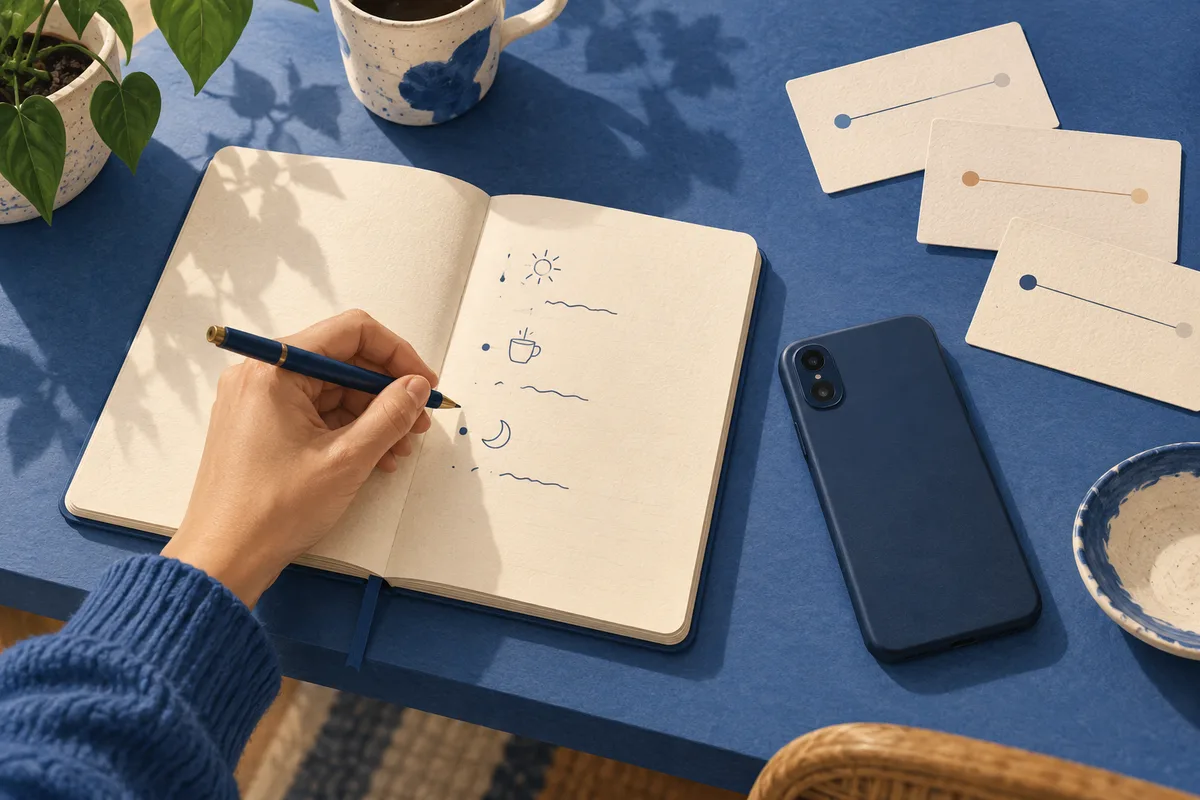
Try a two-pass note. First, describe a few episodes as trigger or setting → phone action → immediate function or consequence. For instance: “While working alone on an unclear task, I opened a messaging app; the task paused, and I felt brief relief.” This is an illustrative format, not a claim about any particular person. Next, consider one or two trait hypotheses and ask what else they would predict. Would the same response appear across different tasks? Does it change when the task is clearer, when another person is present, or when contact is actually needed? Keep only the interpretation that helps explain variation and survives at least one counterexample.
Choose a different next step if your aim is different. If you need a more accurate account of duration, look at the device’s usage summary and note what it cannot explain. If you want to understand a recurring tendency across several areas of life, a personality guide can help you name the broader pattern, provided you keep it dimensional and tentative. If you are mainly trying to change a routine, identify the cue or condition you can adjust and notice what happens. A guide is not required for every practical question.
A private Context Profile is another optional way to reflect on how several everyday tendencies may combine. It uses ten continuums without assigning a type or comparing results to population norms; responses and results stay local unless the reader explicitly requests optional anonymous AI synthesis. It is a reflection instrument, not a validated explanation of phone use. Try it only if seeing a wider personal pattern would help you ask a better question. You can instead explore the personality profile learning library for a specific trait or model.
Verdict: begin with the behavior because it is the thing you want to understand. A personality guide can add useful vocabulary and a broader hypothesis, but the available phone research shows associations at group level and meaningful variation by context. The exception is a question that is already about a broad tendency across many situations; there, a guide may be a reasonable first reading, while a specific phone episode still needs its own context. For the next week, note a few relevant episodes and one exception. Then decide whether a trait framework explains anything the pattern alone did not.
Sources: Situating smartphones in daily life: Big Five traits and contexts associated with young adults’ smartphone use; Typical Phone Use Habits: Intense Use Does Not Predict Negative Well-Being
Questions readers ask
Can screen time tell me which personality trait I have?
No. Screen time measures duration, not the motive or tendency behind it. Similar totals can reflect work, communication, entertainment, or different routines. Record purpose and context before considering a trait explanation.
Does frequent phone use mean I am extraverted?
No. A study of college students found an association between extraversion and more frequent use at group level, but it cannot classify an individual. People use phones for many reasons, and setting also matters.
Should I use phone logs or my memory?
Use a device summary when duration matters, and your notes for purpose, context, and consequence. A study found self-estimates differed from device measures during lockdown, but logs do not explain what the use meant.
When is a personality guide most useful here?
When you have a recurring pattern across more than one setting and a specific tendency to investigate. Treat the guide as a source of questions, then check whether its explanation fits other episodes and exceptions.
Sources and notes
- Typical Phone Use Habits: Intense Use Does Not Predict Negative Well-Being
The four-week logging study of 340 participants derived five broad use profiles and found nightly-use patterns, rather than intensity alone, associated with lower well-being; its Spanish Android sample and observational design limit generalization.
- Situating smartphones in daily life: Big Five traits and contexts associated with young adults’ smartphone use
Two college-student samples (N=634 and N=211) combined surveys, experience sampling and mobile sensing over two weeks; trait and contextual associations support probabilistic, group-level interpretation, not individual causal explanation.
- Problematic smartphone use relationship with pathological personality traits: systematic review and meta-analyzes
A systematic review of five eligible studies found generally low associations, heterogeneity and cross-sectional evidence concerning problematic use; it bounds claims and does not explain ordinary habits.
- Discrepancies Between Self-reported and Objectively Measured Smartphone Screen Time: Before and During Lockdown
An observational study of Portuguese adults found self-report agreement varied by setting; during lockdown participants underestimated device-measured screen time by about 71 minutes per day on average, a context-specific result.
- The role of family functioning: How the Big Five affect metacognitions about smartphone use
A cross-sectional questionnaire study of Chinese college students examined traits, family functioning and beliefs about smartphone use; it supports considering beliefs and context, but mediation models do not establish causal pathways.
- Problematic Mobile Phone Use and Big-Five Personality Domains
A survey of 504 Japanese university students reported a model explaining 13.5% of problematic-use scores, with only selected trait associations; the student sample and self-report outcome cannot generalize to everyday habits.
Apply it to your own pattern
See how your everyday tendencies combine
From this guide: A phone pattern can be clear while its wider relation to planning, attention, social energy, and pressure remains uncertain.
If phone use is one part of a broader pattern you are trying to understand, the Context Profile can help you reflect on how several everyday tendencies sit together across ten continuums. It does not assign a type or explain a phone habit on its own. Review your local results alongside the situations you have observed, then explore the topics library for a specific trait or model.