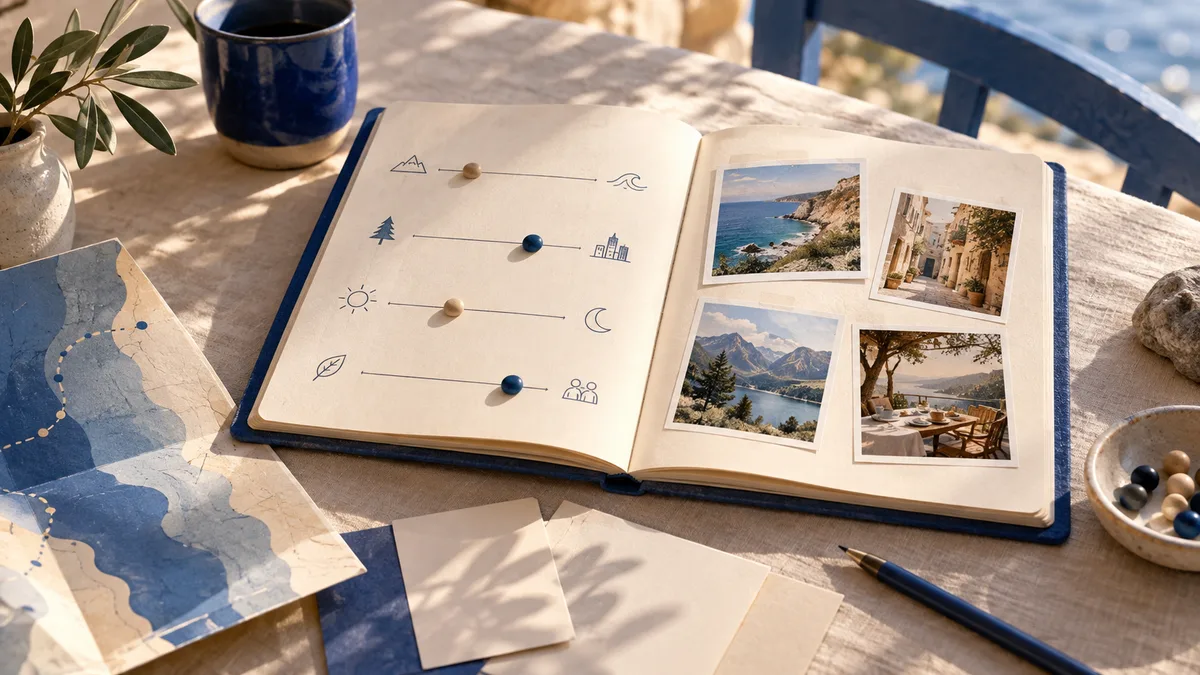
For an individual trip, start with the trips you have actually enjoyed and compare their conditions: pace, planning, companions, novelty, downtime, and friction. Those memories are closer to your decision than a broad personality description, though they are selective and one trip can be an exception. Use a dimensional framework such as the Big Five afterward to name a possible tendency or formulate a question. Treat that interpretation as a hypothesis, then make one small, reversible choice in the next itinerary and observe how it works. Tourism studies find associations between traits and travel outcomes, but they do not establish a reliable personal recipe for a destination or itinerary.
Should a personality framework or your trip history lead?
If you are deciding whether to book a tightly scheduled city break or a slower trip with open days, the most useful first question is not which personality type you are. It is what happened on trips with similar conditions. Did a loose plan leave room for enjoyable discoveries, or did it create repeated decisions and missed reservations? Did a full schedule feel energizing, or did it make every delay costly? These are observable details tied directly to the choice in front of you.
A personality trait is a broad tendency, not a travel instruction. In the Big Five framework, openness refers broadly to interest in new ideas and experiences; conscientiousness includes tendencies around organization and follow-through. A person can be higher or lower on each dimension, and the dimensions do not sort people into a few fixed travel types. A trait description can help you find language for a pattern, but it cannot tell you whether this particular destination, companion, budget, or season will suit you.
Trip history is closer to your own experience, but retrospective: you reconstruct what happened and what mattered. A trait framework is more abstract and may organize impressions across life, while tourism studies usually report group-level relationships between traits and outcomes. For an individual booking, repeated experiences have the stronger starting position because they concern conditions you may choose again.
The experience-sampling review describes methods that record thoughts, feelings, and actions repeatedly, distinguishing a person’s average from variation across situations. It is not travel research and cannot identify an ideal itinerary. It does support a cautious interpretation: a broad tendency can coexist with meaningful variation. Someone who usually likes novelty might still prefer a familiar hotel when traveling with a toddler, while someone who values predictability may enjoy an unscheduled afternoon in a familiar city.
A practical first pass needs only two or three trips. For each, note what you did, who came along, how much structure you had, where the energy rose or fell, and which conditions were unusual. Then look for a repeated feature rather than a repeated label. The goal is not to prove you are adventurous, introverted, or organized. It is to decide whether the next trip should have, for example, one reserved anchor each day, a quiet room, or a full afternoon without plans. Use a framework only if it helps you ask a better question about that choice.
Sources: Experience Sampling Methods: A Modern Idiographic Approach to Personality Research; Memorable tourism experience: A review and research agenda
What can a trait framework tell you about a trip?
Trait research can suggest which travel conditions may deserve attention. It cannot reliably name the destination you should choose. This distinction is easy to lose in popular advice that assigns a vacation style to a type and then prescribes a matching itinerary. Group-level association means that, within a studied sample, a trait and an outcome varied together. It does not establish that the trait caused the outcome, or that the relationship predicts what one reader will enjoy.
A 2007 quasi-field study followed 100 Israeli employees before and after a one-week vacation at a resort village. Its abstract reports that higher conscientiousness was associated with lower negative mood and perceived stress during vacation, and with stronger confirmation of positive affective expectations. Perceived stress mediated some reported relationships. This is useful evidence that individual differences may matter during a holiday. It is a narrow sample and setting, however: employees on a family resort vacation, assessed around one week. The study did not compare city itineraries with hiking trips or test a rule for selecting destinations. Its result cannot tell a reader that conscientiousness means they should plan every hour.
A 2026 Japanese tourism study offers a broader but still bounded view. It analyzed 5,306 valid responses from more than 8,000 participants in a regional destination-management survey, using multiple and logistic regression across pre-trip, during-trip, and post-trip customer-journey outcomes. The publisher abstract reports that companions and traits, especially openness and agreeableness, were associated with behavior, satisfaction, and revisit intention. This suggests that tourism researchers can learn something by studying personality alongside situational factors. The population came from one regional survey, and the abstract does not provide enough detail to translate the results into an individual forecast or a particular itinerary recommendation.
A study of 450 tourists in Gran Canaria used the Big Five and sensation seeking to examine personality as a possible market-segmentation criterion for sun-and-beach destinations. Its publisher record frames the task as assessing potential for destination-market segmentation and notes demographic influences on tourist personality. That is a different aim from helping an individual choose between two trips. A market may use aggregate patterns to describe visitor segments; the result does not establish that a certain trait makes a specific beach destination right for one person.
Taken together, these studies justify curiosity, not a personality-based booking verdict. Openness might prompt the question, ‘Which kind of novelty did I enjoy before: unfamiliar food, a new route, meeting people, or learning a subject?’ Conscientiousness might suggest asking whether advance structure reduced stress, or whether it turned leisure into another checklist. Agreeableness might raise a question about shared decisions and companion needs. Each question needs a concrete answer from experience. A trait earns its place when it points you toward a feature you can observe and choose, not when it substitutes for that observation.
Sources: Mediation of the effects of the big five personality dimensions on negative mood and confirmed affective expectations by perceived situational stress: A quasi-field study of vacationers; The Influence of Tourists' Personality Traits on the Customer Journey; La personalidad del turista como criterio de segmentación de destinos de sol y playa: una aplicación al destino Gran Canaria
Are your favorite trips reliable evidence?
Past trips are relevant evidence, but a memory is not a complete recording. Retrospective recall means reconstructing an earlier experience from memory. A systematic review of 56 peer-reviewed memorable-tourism studies found a literature heavily reliant on retrospective self-report, with varied contexts and unresolved measurement questions. The review describes how memory can be reconstructed and influenced by time, situation, social motives, and the audience with whom an experience is shared. This does not make your recollections useless. It means that a favorite-trip story should be checked against more than its most vivid moment.
A 2024 survey asked 1,200 Japanese respondents about memorable sightseeing trips at different life stages. Quantitative text analysis grouped the experiences into nine categories, including shared trips with family or friends, novelty such as a first trip abroad, aesthetic experiences involving scenery or gastronomy, and journeys around regions such as Hokkaido and Kyushu. The categories shifted across age groups, and the article discusses milestone trips around life transitions as more likely to be remembered. The finding makes a useful point: what becomes memorable can vary with life stage and trip context. It does not show that one travel preference is permanent or that memory alone can recover every detail accurately.
Separate three questions that often get collapsed: What trip was most memorable? Which felt most enjoyable while it was happening? Which conditions would you choose again now? A first international trip may be unforgettable because it was a first, while a quieter repeat visit may have been more restorative. A warm memory may center on one meal or reunion despite a difficult schedule; one stressful delay can also dominate an otherwise enjoyable trip. The answer depends on whether you are planning for novelty, ease, connection, or a particular activity.
Use memory anchors to make the comparison more specific. An old itinerary can remind you how many transfers you made; photographs may show whether most afternoons were active or unstructured; calendar entries can locate the day a favorite event happened. Notes written during or soon after a trip may preserve small irritations that later storytelling tends to omit. If companions remember the same event differently, the difference can be informative: perhaps one person needed more downtime, or perhaps the trip offered distinct experiences to different people. These records add context, not objectivity. They are still partial views.
The strongest personal evidence is a recurring condition across different trips, not a single high point. If three unrelated trips felt easier when mornings were open, that repeated detail deserves consideration. If the only open-schedule trip also had excellent weather, a generous budget, and no travel companions, it is harder to know which feature mattered. Keep positive and negative evidence together: the museum day you loved and the queue that wore you down both describe the practical fit of the trip. This balanced record protects against turning a memorable exception into a rule.
Sources: Experience Sampling Methods: A Modern Idiographic Approach to Personality Research; Memorable tourism experiences: An exploratory study of experiences using quantitative text analysis; Group recommender systems for tourism: how does personality predict preferences for attractions, travel motivations, preferences and concerns?
Why can the same person enjoy different kinds of trips?
A travel preference belongs to a person in a situation. Budget, health, companions, responsibilities, destination access, weather, and life stage can change what feels manageable or rewarding. A person may want a quiet beach after a demanding month and an ambitious walking itinerary during a more spacious season. That variation is not evidence that a trait description was false. It may show that different conditions bring different needs to the front.
The experience-sampling review explains why personality researchers distinguish typical patterns from momentary states. A state is a behavior or feeling in a particular moment; a trait summarizes a broader tendency across observations. Repeated sampling can estimate both a person's typical level and how much they vary across situations. The review is a methods source rather than tourism evidence. Applied carefully, it suggests that the useful planning question is conditional: under what circumstances do I prefer more structure, stimulation, or solitude? A broad label by itself leaves out those circumstances.
Tourism evidence points toward the same need to retain context. The 2026 Japanese survey analyzed companions alongside personality, and its abstract reports meaningful associations for both. The Gran Canaria study considered personality in a bounded beach-destination market. Neither suggests that traits operate alone. Companions may change the pace, interests, and compromises of a trip. A destination built around long walks may be appealing in principle but not workable when one traveler has limited mobility. A group itinerary may create social contact and also reduce time alone.
Imagine comparing two past trips without attaching them to a personality label. One had an early start, several booked activities, and a close friend who enjoyed choosing restaurants. The other involved a later start, a rental car, and a relative who preferred to return to the hotel by midafternoon. If the second felt tiring, it would be premature to conclude that you dislike spontaneity or company. The difference might lie in sleep, transportation, conflicting pace, or the amount of recovery time. This is an illustrative comparison, not a reported case. Its purpose is to show how many explanations sit between a trip outcome and a trait interpretation.
When the same pattern appears under different conditions, a trait lens can help summarize it. Perhaps you consistently welcome unfamiliar neighborhoods but prefer predictable transport and lodging. That is more useful than calling the entire trip style ‘adventurous.’ Or you may enjoy a full day of shared activity when you have a private room and a quiet morning afterward. Naming the specific combination gives you more control than treating travel as one global preference. A framework can help you notice a candidate pattern, while the trip record helps establish when it applies.
Ask what would change your interpretation. If you think you need constant structure because one unplanned trip went badly, compare another flexible trip with different companions and lower stakes. If you believe novelty always energizes you, review a trip where unfamiliar logistics competed with the activity itself. A useful explanation survives comparison with a plausible alternative. When it does not, keep the conclusion local: that particular trip was hard under those conditions. Such precision is more valuable than confidence in an identity label.
Sources: Memorable tourism experience: A review and research agenda; The Influence of Tourists' Personality Traits on the Customer Journey; La personalidad del turista como criterio de segmentación de destinos de sol y playa: una aplicación al destino Gran Canaria
How can you compare trips without turning them into a type?
Use the same small set of features for each trip. A comparison works best when it separates what happened from what you think it says about you. Begin with the observable conditions: travel companions, pace, amount of advance planning, transportation, novelty, social contact, downtime, physical demands, and the events that mattered. Then record a concrete sign of enjoyment or strain. ‘I am spontaneous’ is an interpretation; ‘I liked having two afternoons with no reservation’ describes a choice and its outcome.
A practical table can use four columns: feature, evidence from each trip, effect on the experience, and confidence in the pattern. For example, under pace, note that one trip included three scheduled stops most days and another included one. Under effect, record whether the schedule felt lively, tiring, or both, and when that changed. Confidence should remain modest when the evidence is one trip or when several conditions changed at once. It can rise when the same feature appears across otherwise different trips. This is a reflection aid, not a validated measurement tool.
Include the unglamorous parts. Which transfer created time pressure? Was the hotel far from the activities? Did the group make decisions together or did one person carry the planning? Were meals easy to arrange? Did the trip contain genuine rest, or only free time spent solving logistics? These features can matter more to the next booking than a general preference for culture, nature, or adventure. The memorable-tourism review describes experience as multifaceted, with both internal and external antecedents. That supports looking beyond destination identity to activities, setting, companions, and service conditions, while not assigning one universal causal weight to each feature.
A useful comparison includes counterexamples. If you think you prefer small groups, identify a time a larger group worked well. What was different: shared interests, predictable schedule, personal space, or a strong guide? If you think you need an itinerary, recall whether the schedule itself helped or whether it simply made transport and tickets less stressful. The point is not to disprove a preference. It is to locate the conditions under which it holds, so that you do not overgeneralize from one good or bad experience.
Separate preference from constraint. A trip may have involved early flights because they were cheaper, not because you enjoy mornings. You may have chosen a resort because a companion needed accessibility features, not because it is your ideal format. These choices still affect the trip and deserve a place in the comparison, but they should not be mistaken for freely chosen preferences. Record what you would select again if the constraint changed, while acknowledging whether that alternative is realistic for the next trip.
Only after this comparison should you bring in a framework. Pick one tendency that seems relevant and translate it into a question about an itinerary feature. If openness feels like a possible lens, ask whether unfamiliar activities were enjoyable in themselves or only when travel logistics were settled. If conscientiousness seems relevant, ask whether planning reduced uncertainty or made free time feel like unfinished work. Then search for examples on both sides. The result should be a specific planning condition, not a verdict about your whole personality.
Sources: Experience Sampling Methods: A Modern Idiographic Approach to Personality Research; Memorable tourism experiences: An exploratory study of experiences using quantitative text analysis; Memorable tourism experience: A review and research agenda

Where does each approach earn its place?
Trip comparison is the better first tool when you have relevant experience and need to make a near-term personal choice. It is concrete, inexpensive, and tied to conditions you can alter. It can reveal that you prefer a central hotel, one anchor activity per day, or a quieter evening after group events. Its weakness is that recall can be incomplete and past conditions may not match the next trip. Use more than one trip and distinguish what you chose from what circumstances imposed.
A trait framework earns a secondary role when it supplies useful language across experiences or suggests a question your notes have not answered. Tourism studies show associations between personality variables and travel behaviors or evaluations, but they examine different questions, samples, and outcomes: customer-journey responses in Japan, destination segmentation in Gran Canaria, and vacation stress in an Israeli resort sample. Together they motivate inquiry; they do not form a validated travel formula.
For someone with little travel history, the balance shifts slightly. A framework might help generate a first set of options: more or less structure, familiar or unfamiliar setting, more or less social contact. But even then, the next step should be a low-cost test of a preference, not a strong commitment based on a type. You can choose one flexible day, a refundable activity, or a short local outing with a similar feature. Direct experience becomes more informative once you have it.
For a group trip, neither an individual's trait profile nor a favorite-trip list should decide for everyone. Each traveler can name the conditions that help them enjoy the trip, then the group can look for overlap and trade-offs. One person may want a morning activity, another may need a later start; an itinerary can alternate demanding and open periods. The research supports including companions as a relevant condition, but it cannot resolve a group's values or budget. Those require conversation and agreement.
The approaches also differ in what they can responsibly promise. A personality framework may organize tendencies and encourage reflection. A trip comparison can identify a pattern in remembered personal experience. Neither guarantees satisfaction, predicts compatibility with a destination, or diagnoses why a past vacation went poorly. Transport disruption, cost, health, companion conflict, or a mismatch between expectations and reality may matter more than personality. A strong planning method leaves room for those competing explanations.
The verdict is practical: let repeated, concrete trip features lead; let a dimensional trait framework help interpret or extend them. This recommendation would weaken if a reader's past trips were unusually constrained, poorly remembered, or unlike the trip now being planned. It would also be reasonable to use a framework earlier when there is almost no relevant history, provided its output stays provisional. The choice is not between data and intuition. It is between evidence at different distances from the decision, and the closest evidence should usually have first say.
Sources: Mediation of the effects of the big five personality dimensions on negative mood and confirmed affective expectations by perceived situational stress: A quasi-field study of vacationers; The Influence of Tourists' Personality Traits on the Customer Journey; Experience Sampling Methods: A Modern Idiographic Approach to Personality Research; Memorable tourism experience: A review and research agenda
What should you do before booking the next trip?
Choose two or three past trips and list the features that differed: pace, structure, companions, novelty, downtime, transport, and physical demands. Mark one moment that felt especially good and one point of friction for each. Use itinerary records, photographs, or notes to check your memory, and label uncertain details as uncertain. Look for a repeated condition rather than a repeated destination or personality word.
Next, write one trait-based hypothesis as a question. For instance: ‘Does planning help me enjoy new places, or do I mainly need predictable transport?’ Check it against evidence from more than one trip. If you cannot find a repeated pattern, leave the question open. The aim is not to force an answer but to identify one decision that can be tested without locking the whole trip into a theory.
Make one small itinerary choice from the comparison. You might reserve the first night near the station, protect an unplanned afternoon, or schedule one shared activity followed by independent time. After the trip, note what the choice changed and what other conditions may have mattered. Repeated observations are more informative than trying to judge an entire trip against one broad trait description.
Sources: Experience Sampling Methods: A Modern Idiographic Approach to Personality Research; Memorable tourism experience: A review and research agenda
What would change this conclusion?
The recommendation to start with trip history assumes the memories are reasonably relevant and that at least some past conditions resemble the upcoming choice. If all prior trips were school tours, family obligations, or work travel, they may tell you less about a solo break or a trip with young children. If a major change in health, budget, mobility, or responsibilities has altered what is feasible, older preferences deserve less weight. Treat past patterns as evidence from a particular period, not as permanent instructions.
The research could also shift the balance if future studies tested individual travel recommendations prospectively across varied destinations and populations, then showed that trait-based choices reliably improved outcomes over simpler preference questions. The opened studies do not establish that. A large regional survey may detect relationships that are useful for destination marketing, and a field study may reveal associations during a specific vacation, but neither by itself validates a personal recommendation method. More replication, transparent measures, and tests against alternative explanations would be needed.
The strongest exception is a reader with little relevant experience who still needs a starting point. A framework can then help identify dimensions to explore, especially if each suggestion is converted into a modest, reversible choice. It should not turn a label into a destination rule. For everyone, the best available conclusion remains conditional: compare actual trips first when they offer relevant examples; use traits to frame hypotheses; update the plan when new evidence arrives. Before booking, tell a travel companion one concrete pattern you have noticed and ask which condition they would most like to protect in the next itinerary.
Sources: Memorable tourism experience: A review and research agenda; The Influence of Tourists' Personality Traits on the Customer Journey
Questions readers ask
Can a personality test tell me what kind of vacation to book?
It can suggest tendencies to reflect on, but current travel studies do not establish a reliable personal itinerary prescription. Compare conditions from trips you have actually taken and use a trait as a question, not a booking rule.
Are past travel memories better evidence than a personality profile?
For a personal planning decision, relevant repeated experiences are usually the closer evidence. Memories are selective, so compare more than one trip and check details against itineraries, photos, or notes where possible.
How can I use personality ideas without stereotyping myself?
Describe tendencies as possibilities, then look for observable examples and exceptions. Ask when a preference appears, what conditions accompany it, and whether the same pattern recurs across different trips.
Sources and notes
- Experience Sampling Methods: A Modern Idiographic Approach to Personality Research
Supports distinguishing typical personality tendencies from within-person variation across situations; it is a methods review, not a travel study.
- Memorable tourism experience: A review and research agenda
Synthesizes 56 studies and describes retrospective self-report, recall reconstruction, geographic concentration, and measurement limitations.
- Mediation of the effects of the big five personality dimensions on negative mood and confirmed affective expectations by perceived situational stress: A quasi-field study of vacationers
Reports associations in a pre/post field study of 100 Israeli employees during a one-week resort-village vacation; does not prescribe itineraries.
- The Influence of Tourists' Personality Traits on the Customer Journey
Publisher abstract reports regression analyses of 5,306 valid responses in one Japanese regional tourism survey across three trip stages.
- La personalidad del turista como criterio de segmentación de destinos de sol y playa: una aplicación al destino Gran Canaria
Publisher record describes a 450-tourist Gran Canaria study using Big Five traits and sensation seeking for destination-market segmentation.
- Memorable tourism experiences: An exploratory study of experiences using quantitative text analysis
Reports a retrospective survey of 1,200 Japanese respondents, nine experience categories, and variation in memorable trips by life stage.
- Group recommender systems for tourism: how does personality predict preferences for attractions, travel motivations, preferences and concerns?
Reviews prior work and models Big Five associations with tourism preferences using a Portuguese snowball-sampled online questionnaire.
- How to Pick the Right Sort of Vacation for You
Opened public example of type-based vacation advice; used to identify the need for a more cautious personal evidence comparison, not as empirical support.
Apply it to your own pattern
See how your tendencies combine across situations
From this guide: Trip preferences can shift with companions, pace, novelty, and the need for recovery; the remaining question is how several tendencies show up together for you.
Comparing trips can show which conditions repeatedly helped, while a single trait may leave the pattern incomplete. The Context Profile presents ten everyday continuums for reflecting on how tendencies combine across situations. It can help you form a question about your broader patterns; check that question against the trips you have actually taken. It is a reflection tool, not a travel recommender or a validated prediction.