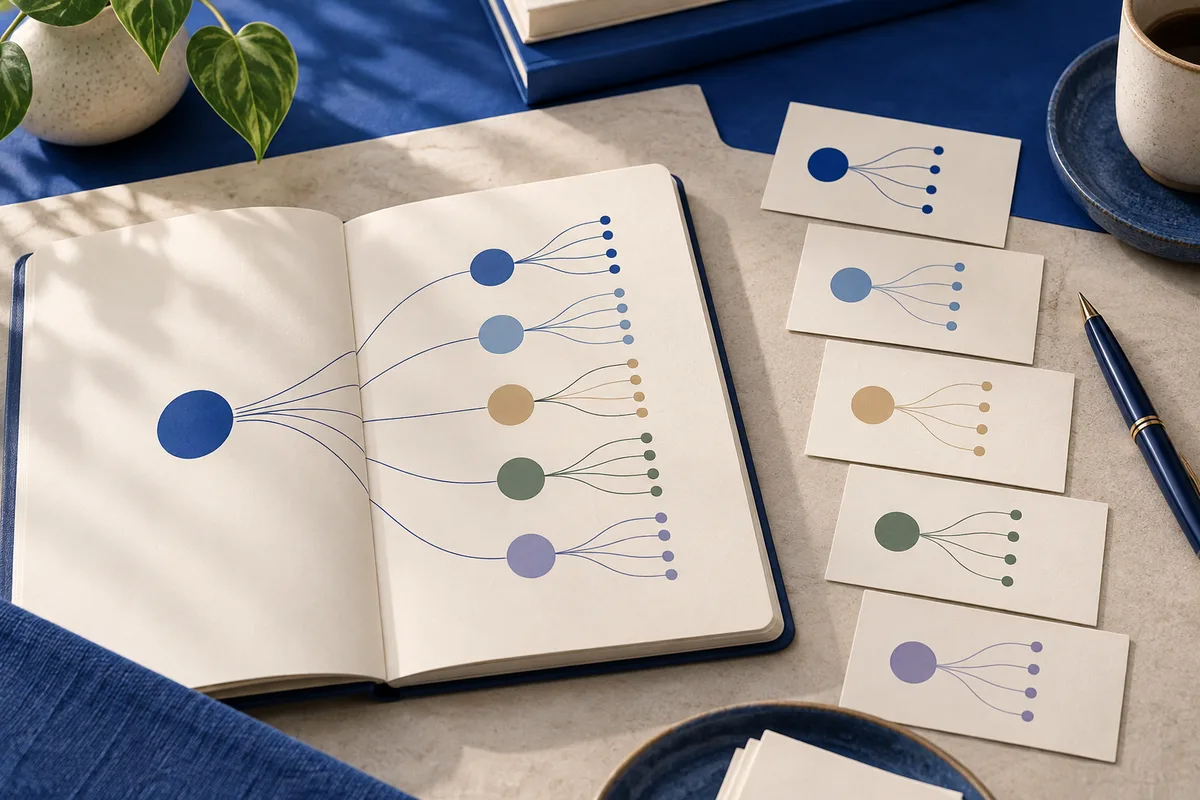
A facet in the NEO PI-R is a narrower personality scale grouped under one of five broad domains, such as Extraversion or Conscientiousness. The inventory has six facets per domain. A domain offers a compact overview; its facets show which kinds of tendencies contribute to that summary. If a broad label feels too general, the facets can suggest a more specific behavior to notice. They describe a particular instrument’s map of personality, though, not six fixed pieces that define every person or every version of the Big Five.
What does a facet add to a broad trait?
A domain is one of the NEO PI-R’s five broad dimensions; a facet is a narrower scale nested within it. The revised inventory organizes each domain into six facets, for 30 altogether. Costa and McCrae describe the broad level as a rapid overview and facet interpretation as a more detailed assessment. In ordinary terms, the domain answers “what is the broad pattern?” and a facet asks “which particular tendency is part of it?”
Consider Extraversion. Its NEO PI-R facets include gregariousness, assertiveness, activity, and positive emotions, among others. Wanting company, taking the lead, moving at a brisk pace, and often experiencing positive emotion are distinguishable tendencies, even though they sit under one broad domain. The distinction helps explain why “extraverted” need not mean socially bold in every situation. A facet label points toward a narrower topic for observation; it does not describe every part of someone’s behavior.
This six-part arrangement is a feature of the NEO PI-R, rather than a universal rule about how many components each broad trait must contain. In their account of the inventory, its developers explain that they chose six to represent distinctions they considered useful, and because adding more would become difficult to manage. That rationale makes the architecture understandable, while leaving room for other researchers to draw the boundaries differently.
Sources: Domains and facets: hierarchical personality assessment using the revised NEO Personality Inventory; Domains and Facets: Hierarchical Personality Assessment Using the Revised NEO Personality Inventory (full text)
Why might facets change how I read a domain?
A broad summary can conceal variation among the narrower tendencies grouped beneath it. Imagine, as a conceptual illustration rather than real test data, two people described as conscientious. One may be notably orderly, while another may be more oriented toward achievement; other facets also contribute to each domain pattern. The shared word gives a useful overview, but it does not establish that both people approach tasks in the same way.
A publisher’s NEO-PI-3 self-interpretive sample report, from the later revision rather than the NEO PI-R, illustrates a related caution: it says a broad description may be harder to interpret when its facets vary widely, and broad and facet descriptions can point in different directions. That is version-specific publisher guidance, not a finding that every profile behaves this way or evidence that any score is accurate. The original NEO PI-R paper supports reading domains as overviews and facets as added detail; the later sample report only illustrates how that distinction can matter in a report. If a broad label seems incomplete, ask what its narrower descriptions add before deciding the summary fits.
Turn the description into an observable question. If the issue is conscientiousness at work, for example, ask whether the relevant pattern concerns arranging materials, meeting obligations, persisting with a task, or thinking carefully before acting. Then look for examples in the setting that matters. This is a reflection prompt, not a substitute score interpretation: the same behavior can also reflect a deadline, unclear instructions, available resources, or learned routines. A facet can make the question more precise without proving why a behavior occurred.
Sources: Domains and facets: hierarchical personality assessment using the revised NEO Personality Inventory; Between facets and domains: 10 aspects of the Big Five
Are these six facets the only way to divide each trait?
No. The NEO PI-R’s six facets explain how that inventory organizes its scales, but they are not the only proposed middle layer between broad domains and narrower behavior. DeYoung, Quilty, and Peterson analyzed 75 facet scales from two major Big Five inventories in one community sample and reported two correlated aspects within each domain. They then developed and tested a measure of those ten aspects in a second sample. Their aspects are a separate research framework, not extra NEO PI-R scales or a replacement that the study established for everyone.
A study of NEO PI-R Agreeableness by Newgent and colleagues examined 240 adults aged 18–65 using correlational analyses and confirmatory and exploratory factor analyses. They reported that the six facet scales fit the domain, while the item-level six-facet model did not fit well; only 35 of 48 Agreeableness items loaded saliently on their intended facet. This result is limited to one domain and this sample and analysis. It does not show that all facets fail, but it cautions against treating every item-level subdivision as equally distinct or secure.
The useful verdict is to read a NEO PI-R facet as a more specific, instrument-defined tendency within a broad trait. Use the domain when you need the overview and the facet when you need a sharper question about what to notice. If a description does not match examples across the situations you care about, treat that mismatch as a reason to reconsider the interpretation, not to force the label. For a work decision, compare the tendency with the role’s actual demands and your experience; neither a domain nor a facet chooses a career.
Sources: Domains and Facets: Hierarchical Personality Assessment Using the Revised NEO Personality Inventory (full text); NEO-PI-3 Self-Interpretive Sample Report; The Construct of Agreeableness: Facet vs. Item Level Analysis
Questions readers ask
How many facets does the NEO PI-R include?
It groups six facet scales under each of five broad domains, for 30 facets total. That is the NEO PI-R’s structure, not a claim that every Big Five framework uses the same subdivisions.
Is a facet the same as a separate personality type?
No. A facet is a narrower scale within a broad domain. It describes a tendency, not a type identity or a complete account of someone’s behavior.
Why can a facet description seem different from its broad trait?
A broad domain summarizes several narrower scales, and those facets can vary. The specific facet descriptions may therefore add nuance to, or complicate, the broad summary.
Sources and notes
- Domains and facets: hierarchical personality assessment using the revised NEO Personality Inventory
The abstract defines the NEO PI-R structure as six facets within each of five domains and distinguishes overview from detailed interpretation.
- Domains and Facets: Hierarchical Personality Assessment Using the Revised NEO Personality Inventory (full text)
The authors state that six facets were chosen for useful distinctions and practical manageability, not because six is inherently special.
- Between facets and domains: 10 aspects of the Big Five
The abstract reports a two-aspect-per-domain framework from analyses of facet scales in two samples.
- NEO-PI-3 Self-Interpretive Sample Report
The publisher sample report is for the later NEO-PI-3, not the NEO PI-R; it illustrates related version-specific guidance that wide facet variation can complicate a broad interpretation.
- The Construct of Agreeableness: Facet vs. Item Level Analysis
In a sample of 240 adults aged 18–65, correlational, confirmatory factor, and exploratory factor analyses of NEO PI-R Agreeableness found six facet scales fitting the domain, while the item-level six-facet model fit poorly; only 35 of 48 items loaded saliently on their intended facet. Limits: one domain and one sample.
Apply it to your own pattern
Compare a tendency with the work a role actually asks of you
From this guide: A facet can sharpen a question about planning, social energy, or follow-through, but a job fit judgment also depends on the role’s conditions and your experience.
If a broad trait label feels too general for a work decision, it may help to see how several tendencies combine in your own reflection. The Context Profile offers a private, non-diagnostic way to explore everyday tendencies across ten continuums; it does not match people to jobs. Your results stay local unless you explicitly request optional anonymous synthesis. Use any pattern as a prompt, then compare it with the role’s actual demands and your work history.