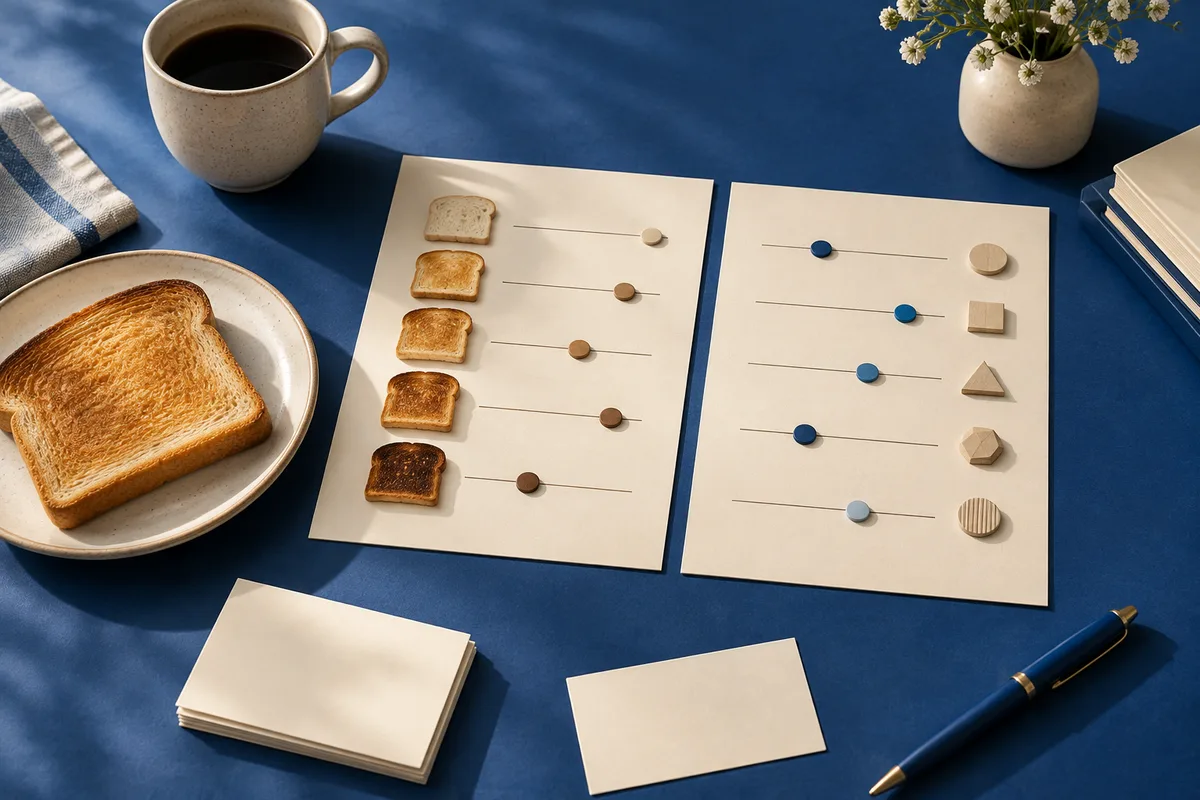
For one food, start with what you know about its history, preparation, and taste. Keep willingness to try it separate from liking it after tasting and choosing it later. Personality research links some measured tendencies with particular food behaviors, but those group associations cannot explain one person’s preference. A broader tendency is a useful hypothesis only when a similar pattern recurs across different foods and occasions; even then, it describes a pattern rather than proving its cause.
Start with the food, then ask whether the pattern travels
To separate familiarity from a personality-based explanation, first describe this food and this response: what you knew or had tried before, what it was like on this occasion, and whether you liked it after tasting. That is an account of one item, not yet an account of a trait. Then ask whether a similar approach or avoidance appears with different foods and occasions. Recurrence can make a broad, dimensional tendency a useful description; it still cannot establish why the preference began. Research links some personality measures with particular food behaviors, but those group-level associations do not identify the cause of one person's liking for one item. Keep the questions distinct: history and immediate features help explain the response in front of you, while a wider pattern may describe how you often respond. The distinction is a way to compare observations, not a validated test of individual causes. The next sections clarify what familiarity includes and why willingness, liking and later choice should not be treated as interchangeable.
What does familiarity mean for one particular food?
For a single food, familiarity means the relevant knowledge or experience that existed before the occasion you are trying to understand. It can be knowing the food's name or appearance, recognizing its ingredients or category, knowing how it is usually prepared, or having tasted that particular item before. Those are not identical histories. Someone may recognize a dish without knowing its ingredients, know a recipe by reputation without having eaten it, or have tried a food once without recognizing a changed preparation. Naming the kind of familiarity matters because a general statement such as “I know this food” can conceal what was actually known.
The useful record is modest and time-bounded: what did you recognize or remember before this serving, and what had you personally experienced? If the answer is uncertain, preserve that uncertainty. A remembered meal, a family description, repeated exposure, and direct experience with the same preparation are different clues; memory rarely supplies a reliable count of how many times something was eaten. This distinction keeps a food's past from being mistaken for a personality label. It also avoids claiming a precise exposure history when all that is available is a broad recollection.
The review *A narrative review on food neophobia throughout the lifespan: relationships with dietary behaviours and interventions to reduce it* covers 139 human studies and treats familiarity, liking or hedonic response, preference, and willingness as related but distinct topics. Across the literature, familiarity can be operationalized in different ways, and the measures and populations vary. That makes the word useful as a starting category, not a single standardized quantity that can be read directly from memory. In your own account, specify whether “familiar” means recognizable, known by ingredients or preparation, previously tasted, or repeatedly encountered; do not assume these forms carry the same information.
Most importantly, familiarity is not the same as liking. A person can recognize a food and dislike it, or remember little about it and still enjoy the present serving. A past taste may help explain why the item feels expected or recognizable, but it does not tell you what the current taste was like. Likewise, liking this serving does not prove that prior exposure produced the liking. The review reports varied relationships rather than a universal rule that familiarity guarantees acceptance, and its mostly cross-sectional, heterogeneous evidence cannot tell which kind of prior knowledge explains one individual's response. For the food in question, write down what was familiar before the occasion separately from whether it was wanted, liked after tasting, or chosen later. These distinctions preserve what you observed while leaving the cause open for comparison with other evidence.
What changes when willingness is separated from liking?
Willingness to try a food and liking its taste are different responses because they answer different questions. Before a bite, willingness can register whether someone is ready to approach an item; expected liking is a forecast made without that occasion's sensory evidence. After tasting, a liking judgment includes the flavor and texture actually encountered. A person might therefore hesitate at an unfamiliar-looking dish and then enjoy its taste, or feel willing to try it and discover that the flavor is unpleasant. Neither sequence is paradoxical: anticipation and sensory evaluation need not agree. A single answer about whether someone likes a food can conceal that distinction, especially when the question is asked before tasting or recalled afterward. The timing of a response changes what it can reasonably tell us. Anticipation can be shaped by what a person expects or is prepared to approach; the later rating concerns the sample encountered. Treating them as one outcome can blur whether a response reflects forecast, willingness, or sensory evaluation.
The study “Assessing Food Neophobia: The Role of Stimulus Familiarity” separated familiarity, willingness and expected liking before sampling from liking reported after sampling. Its abstract reports that familiar foods received more positive evaluations overall, but the difference between neophobic and neophilic groups was greatest for willingness and smallest for liking after sampling. That pattern matters because a group contrast in readiness to try did not carry over unchanged to sensory liking. Hesitation can therefore be evidence about approach in that moment, without serving as a direct measurement of how pleasant the food tastes once sampled. Conversely, willingness alone does not establish that the eventual taste will be liked. The abstract gives no sample size or detailed food-specific results, so the comparison should stay at this reported group level.
For interpreting one response, the useful distinction is modest: a before-taste reluctance describes anticipation, while an after-taste rating describes the experience of that sample. The study does not show that tasting removes reluctance, that sensory information always overrides it, or that a particular reader would change their mind. Familiarity was also part of the study's comparisons, so the group pattern cannot establish that familiarity caused an individual's later liking. A food may taste pleasant while remaining something a person is hesitant to approach on another occasion; likewise, willingness may reflect openness to trying rather than a settled preference. These measures provide different clues, not a personality verdict. Keeping their meanings distinct prevents a moment of caution from being mistaken for dislike, and a favorable forecast from being mistaken for enjoyment.
Sources: Assessing Food Neophobia: The Role of Stimulus Familiarity
What can earlier food experience explain—and what can it not?
Earlier experience is a plausible part of a food's history, but the evidence here supports an association rather than a single-cause explanation. “Perceived recollection of frequent exposure to foods in childhood is associated with adulthood liking” surveyed 670 college students about remembered childhood food experiences and current liking. The abstract reports that perceived frequent childhood consumption was associated with adult liking for most foods queried. It also reports associations involving remembered parental encouragement or modeling and restriction or forced consumption. These findings make it reasonable to take food history seriously: remembered repetition and family practices covaried with how these students said they liked foods as adults. The result does not mean that every participant's current preference was caused by exposure, nor does it tell us which part of a particular reader's history mattered. In particular, reported frequent consumption is not the same as a verified record of how often a food appeared, and remembering a food as liked does not identify the process by which that liking developed.
The distinction between an association and a causal effect is especially important because the survey asked people to recall earlier experience rather than following assigned exposure over time. Current liking could shape which childhood experiences feel memorable; memories may also be incomplete or reconstructed. Family practices can travel together with other influences, including culture, availability, recipes and preparation. The study's associations involving parental encouragement, modeling and restriction show that the remembered history was not simply a count of tastes in isolation. But the abstract does not establish that those factors caused adult liking, or that the researchers separated their effects from one another. Nor can moderate agreement between student and parent recollections turn retrospective reports into a controlled record of each person's exposure.
A careful inference for an individual is therefore that earlier experience belongs among the plausible explanations to examine, not that it settles the explanation. If a food was regularly present in a person's childhood, that history may be relevant context for understanding present familiarity and liking; this study does not prove the history produced either one. A reader might remember who prepared a food, how it was served, whether trying it was encouraged or pressured, and whether its ingredients or recipe changed over time. Those details can reveal several competing histories, but recollection remains evidence about remembered experience. They should not be collapsed into a claim that exposure alone explains a preference, or that personality must explain what history leaves uncertain. The study establishes covariation in its surveyed group, while the cause of any one person's liking remains unresolved by that result.
What does the whole-grain trial actually show?
The six-week trial does not establish that familiarity independently caused liking to improve. “Liking and Acceptability of Whole Grains Increases with a 6-Week Exposure but Preferences for Foods Varying in Taste and Fat Content Are Not Altered: A Randomized Controlled Trial” assigned 45 healthy adults who described themselves as low whole-grain consumers to baskets of whole-grain or refined-grain products. That design makes the comparison between arms central to judging an exposure effect. The report describes changes in some grain-specific ratings or willingness over time within the whole-grain arm, but changes also occurred in measures in the refined-grain arm. A before-and-after change within one group tells us that its measurements differed across time; it does not tell us whether the change was caused by the assigned whole-grain products. Participants may change over time for reasons shared by both groups, and an apparent shift can also reflect variation in the measurements. The randomized contrast is what helps distinguish changes associated with the assigned products from those that also appear without that assignment.
The relevant question is therefore not simply whether a rating rose in the whole-grain group, but whether its change differed from the change in the refined-grain comparison, in a way the report supports as an intervention effect. The trial's reported pattern does not warrant the earlier assertion that the whole-grain group's improvement makes exposure the more plausible cause. This is a correction about how to read this particular experiment, not proof that exposure can never affect liking. The report does contain changes in some grain-specific measures; those findings remain worth describing at their actual scope. Its participants, product baskets, healthy-adult sample and six-week period do not stand in for a single familiar dish, an individual's food history, or every kind of exposure. Nor can the trial say why a particular person likes one item: its arm-level results do not identify an individual's cause. At most, it shows why an observed increase over time must be interpreted alongside the control group's trajectory before attributing it to the exposure. The result narrows what this cited study can support; it does not settle every question about familiarity or liking.
This distinction also prevents two different statements from being collapsed. “Some ratings changed during the study” describes observations over time. “The assigned exposure caused the change” is a comparison-based causal claim. The first can be true without the second being established, particularly when the comparison arm also changes. Readers can carry that logic into the article's narrower question without treating a food experiment as a personality study: evidence about a group of grain consumers cannot assign a cause to an individual preference, and it says nothing direct about a personality tendency. For one food, the trial neither licenses an exposure-only account nor creates a reason to default to personality. It simply cannot do the individual explanatory work that the former claim gave it. Keep its contribution bounded to grain products, these participants, the measures reported and the comparison over six weeks.
Which features can imitate a familiarity effect?
A familiar-versus-unfamiliar contrast can hide another difference: the way a food is represented may itself change how it is rated. In “High arousal as the source of food rejection in food neophobia,” more than 7,000 consumers across Australia, the United Kingdom, Singapore and Malaysia rated the familiarity, liking and arousal of standard and manipulated food names. Lower-familiarity names and variants rated as higher in arousal were associated with lower liking, with patterns varying by food-neophobia scores. This makes a simple familiarity-only reading incomplete: in this task, liking ratings varied alongside both familiarity and the arousal associated with a name. The finding does not establish that arousal caused a rating, or that a reader's response to a tasted dish arose from the same process. Participants judged names rather than eating meals, so the study cannot tell us whether an actual dish was more intense, how its ingredients tasted, or whether its preparation produced a particular response. It complicates interpretation of a rating; it does not identify a sensory mechanism for a meal.
For a naturally occurring experience, a useful next distinction is whether the response followed the food itself or a change in how it appeared on that occasion. A reader might notice that a known dish was prepared differently, tasted more intense, included a changed ingredient, or was served in a different setting. These are practical comparison points inferred from the article's question, not variables tested by the food-name study. If the details are already part of the person's experience, recording them helps describe what differed without assuming which difference mattered. The same name can refer to food prepared in more than one way; familiarity with the name or category therefore need not mean familiarity with this particular version. Conversely, a changed name or description can alter an expectation even when the meal itself has not been tasted yet. Keeping representation and experience distinct helps avoid treating an expectation as a sensory report.
This is not a request to arrange controlled tastings or to diagnose a sensitivity from a preference. It is simply a way to avoid assigning every difference in liking to familiarity: note the preparation, ingredients, intensity or setting only when a relevant change occurred, and say what was directly noticed rather than what must have caused the response. The name-rating study supports considering more than familiarity when interpreting food-name judgments. It cannot rank meal-level explanations or tell a reader which feature explains an actual bite. If no such difference is known, there is no need to invent one; the response can remain unexplained at this level. These observations refine the description of one occasion. They still do not show a personality pattern, which requires evidence beyond a single food response.
Sources: High arousal as the source of food rejection in food neophobia
What does personality research connect to food behavior?
Personality research does connect some measured tendencies with food behavior, but the evidence describes associations in particular samples and outcomes. It supports treating a trait as one possible way to describe a broader pattern, not as the cause of an individual's liking for a familiar food. Two findings illustrate the distinction: one concerns approach and avoidance around unfamiliar foods; the other concerns liking for spicy foods. Neither supplies a general food personality or a reliable explanation for a single preference.
In “Food neophobia and the Five Factor Model of personality,” 716 undergraduates completed measures of Big Five traits and food neophobia. The reported associations differed by direction of behavior: approach was positively associated with Openness and Agreeableness, while avoidance was negatively associated with Openness and Extraversion. This is more informative than saying that one personality type is adventurous or picky. The study links dimensional scores with distinct approach and avoidance measures; those are not interchangeable responses, and the reported pattern does not mean that everyone higher on one trait behaves alike. A tendency can be more or less pronounced, and a person's response may depend on the food and situation. These group-level correlations also leave open whether the measured traits explain the behavior, whether behavior and traits share other influences, or how well the pattern describes anyone outside this undergraduate sample.
A different, narrower result appears in “Personality factors predict spicy food liking and intake.” Sensation seeking correlated positively with liking for spicy foods, but not with liking for non-spicy control foods in that study. The specificity matters: the result concerns a particular category of liking, rather than a general readiness to try unfamiliar food. The study also treated related outcomes separately. Reported chili-consumption frequency had associations with sensation seeking and reward sensitivity, whereas perceived capsaicin burn or sting was not associated with the personality measures. Thus liking, how often someone reports eating chili, and how intense the burn feels cannot be substituted for one another. A person could report liking a spicy food without a personality score explaining the sensory experience, and a pattern in spicy-food liking says nothing direct about a familiar non-spicy dish.
Taken together, these findings make a limited personality account credible: some trait measures covary with some food-related behaviors or specific likes. They do not show that personality caused those responses, and they do not establish that a preference is fixed. The Big Five result concerns approach and avoidance in undergraduates; the sensation-seeking result concerns spicy-food measures. Different constructs and outcomes should remain separate rather than being folded into a stereotype such as “open people eat everything” or “sensation seekers like all intense foods.” Those claims exceed the reported associations and erase the variation between people and occasions.
For the question of one familiar food, a measured tendency is therefore a candidate description only if observations beyond that item fit it. The research cannot tell whether familiarity, preparation, culture, access, a particular sensory feature, or some combination accounts for this person's liking. Nor can a correlation assign a cause to a single reader. The useful conclusion is modest but real: personality and food behavior are not wholly unrelated, yet the evidence here is too narrow to identify why one person likes one familiar item. A broader description becomes more useful only when it helps organize repeated behavior across foods, while remaining open to food-specific explanations.
Sources: Food neophobia and the Five Factor Model of personality; Personality factors predict spicy food liking and intake
When does a broader pattern earn a personality explanation?
A personality description becomes more useful when the same kind of approach or avoidance appears across distinct foods and more than one ordinary occasion. If the response is confined to one dish, one recipe, or one sensory feature, the food-specific account currently explains more of what is observed. This is an editorial decision rule for organizing observations, not a validated measure, an empirical threshold, or proof of cause. It helps decide which description fits the available evidence better; it does not determine why the pattern exists.
The comparison is between the reach of the pattern and the reach of the explanation. A response tied to a particular preparation, remembered history, or recognizable feature has a close food-level match: it accounts for why this item or version stands out. A similar response toward distinct foods with different histories and features gives a broader tendency more descriptive value, especially when it recurs without the same obvious trigger. “More descriptive value” means the tendency summarizes several observations; it does not mean that a personality trait produced them. A recurring pattern can still travel with a shared context, such as family practice, culture, availability, or a sensory response that several foods have in common.
One way to apply the rule is to ask what would make each account less plausible. If the preference changes when the recipe or preparation changes, or if other foods do not draw the same response, that weighs toward an item-specific description. If a comparable approach or reluctance appears with multiple unrelated foods across occasions, the cross-food description gains support. These are observations to notice in ordinary life, not a request to stage tests or seek out foods. There is no required number of examples: a threshold would imply a precision this method does not have. When evidence is sparse or mixed, retain both possibilities or leave the explanation undecided.
For illustration only, suppose someone likes one strongly flavored dish but avoids unfamiliar versions of that same dish. That pattern alone could reflect its known recipe or the particular flavor, so it would not yet justify a broad personality label. If a similar approach toward unfamiliar foods appeared across unrelated meals, a general tendency to approach novelty might describe the observations better. Even then, shared upbringing, access, or a recurring sensory quality could explain why those occasions resemble one another. The illustration tests the comparison rule; it is not evidence about real people or a way to infer a trait from a single food.
The conclusion should change when the observations change. Repeated examples across distinct foods can make a dimensional personality description more useful; evidence that the response follows one recipe, history, or feature can return the explanation to that food. Neither outcome settles causation, and recurrence does not turn a tendency into an identity or diagnosis. Use the broader account only while it adds a concise description of what happens across settings. If it stops clarifying the observations, or if several explanations remain equally plausible, keep the account provisional and let the food-specific response remain partly unexplained.
A next step: describe the response before naming it
For one food, write down what happened before deciding what it says about you: how familiar the food and this particular preparation were; the context, ingredients or preparation that stood out; whether you were willing to taste it beforehand; how much you liked it after tasting; and whether you chose it later when it was available. Keep each note close to what you noticed. “I hesitated before tasting, then liked the flavor” is more useful than “I am a picky person,” because it keeps willingness, experience and later choice distinct.
This is self-reflection, not a test, and it does not need a schedule. Compare another food only if an ordinary occasion gives you a relevant example; do not seek repeated exposure to prove a point or expect liking to change. If the pattern across examples is mixed, or several explanations still fit, leave the cause unresolved. A food preference alone cannot establish a personality trait. The private [Context Profile](/assessment) reflects on broader tendencies, but it is not food-specific and cannot explain this preference. For more on personality patterns, [explore the learning library](/topics).
Sources and notes
- Assessing Food Neophobia: The Role of Stimulus Familiarity
In a food-sampling study, participants rated familiarity, willingness, expected liking before tasting, and actual liking after sampling; familiar foods were rated more positively, and neophobic/neophilic groups differed most in willingness and least in post-sampling liking.
- A narrative review on food neophobia throughout the lifespan: relationships with dietary behaviours and interventions to reduce it
The review included 139 human studies, reports food neophobia associations with familiarity, hedonics and willingness, and concludes it is not an unchangeable personality trait; evidence for interventions is limited and age-bound.
- Perceived recollection of frequent exposure to foods in childhood is associated with adulthood liking
Among 670 college students, retrospectively perceived frequent childhood consumption was associated with current liking for most queried foods; recalled parental encouragement/modeling and restriction/forced consumption were also associated with liking.
- Liking and Acceptability of Whole Grains Increases with a 6-Week Exposure but Preferences for Foods Varying in Taste and Fat Content Are Not Altered: A Randomized Controlled Trial
In a six-week randomized study of 45 healthy adults who self-identified as low whole-grain consumers, whole-grain intake and some within-group ratings changed, but ratings/willingness also changed in refined-grain controls; the report does not support saying the whole-grain exposure independently caused the liking change. Do not generalize this food-group trial to one familiar dish or personality.
- High arousal as the source of food rejection in food neophobia
More than 7,000 consumers across Australia, the United Kingdom, Singapore and Malaysia rated familiarity, liking and arousal for manipulated food names; lower familiarity and higher-arousal variants aligned with lower liking, with stronger patterns at higher food-neophobia scores.
- Food neophobia and the Five Factor Model of personality
In 716 undergraduates completing Big Five and food-neophobia measures, approach and avoidance dimensions had different trait associations: approach was positively associated with Openness and Agreeableness; avoidance was negatively associated with Openness and Extraversion.
- Personality factors predict spicy food liking and intake
The study reported positive correlations of sensation seeking with liking for spicy foods, but not non-spicy controls; perceived capsaicin burn/sting was not associated with personality measures, while chili-consumption frequency related to sensation seeking and reward sensitivity.
Apply it to your own pattern
See how your tendencies combine across situations
From this guide: A food preference is too specific to establish a personality pattern; the remaining question is whether similar tendencies recur in other parts of everyday life.
This comparison can clarify one food response, but it cannot show how that response fits with your wider tendencies. The Context Profile offers a private reflection on patterns across several everyday continuums. Use it to explore how tendencies may combine, while keeping the food preference grounded in its own history and sensory context.